
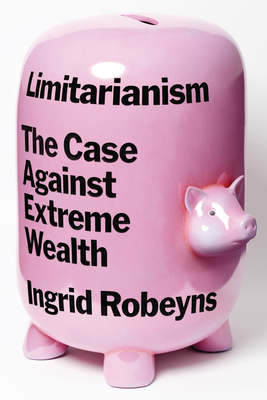
Limitarianism: The Case Against Extreme Wealth
| AUTHOR | Robeyns, Ingrid |
| PUBLISHER | Astra House (01/16/2024) |
| PRODUCT TYPE | Hardcover (Hardcover) |
Description
A New Yorker Best Book of 2024
A History Today Book of the Year "A powerful case for limitarianism--the idea that we should set a maximum on how much resources one individual can appropriate. A must-read!"
--Thomas Piketty, bestselling author of Capital in the Twenty-First Century An original and galvanizing indictment of the world's uber-rich that boldly argues for a cap on wealth from the philosopher who coined the term "limitarianism." How much money is too much? Is it ethical, and democratic, for an individual to amass a limitless amount of wealth, and then spend it however they choose? As democracies weaken, our climate becomes increasingly unpredictable, and inequality worsens, many of us feel that the obvious answer is no - but what can we do about it? Economist and philosopher Ingrid Robeyns has long written and argued for the principle she calls "limitarianism" - a "common sense" (Jia Tolentino) case against extreme wealth which posits that a considered cap on one's individual wealth is an urgent ethnical concern that will ultimately lead to healthier, more democratic societies. In this "provocative consideration of extreme wealth accumulation" (The New Yorker) Robeyns ignites an urgent debate about wealth and when, how and why to limit it, calling into question the legitimacy of capitalism and neoliberalism and inviting us to a radical reimagining of our world.
A History Today Book of the Year "A powerful case for limitarianism--the idea that we should set a maximum on how much resources one individual can appropriate. A must-read!"
--Thomas Piketty, bestselling author of Capital in the Twenty-First Century An original and galvanizing indictment of the world's uber-rich that boldly argues for a cap on wealth from the philosopher who coined the term "limitarianism." How much money is too much? Is it ethical, and democratic, for an individual to amass a limitless amount of wealth, and then spend it however they choose? As democracies weaken, our climate becomes increasingly unpredictable, and inequality worsens, many of us feel that the obvious answer is no - but what can we do about it? Economist and philosopher Ingrid Robeyns has long written and argued for the principle she calls "limitarianism" - a "common sense" (Jia Tolentino) case against extreme wealth which posits that a considered cap on one's individual wealth is an urgent ethnical concern that will ultimately lead to healthier, more democratic societies. In this "provocative consideration of extreme wealth accumulation" (The New Yorker) Robeyns ignites an urgent debate about wealth and when, how and why to limit it, calling into question the legitimacy of capitalism and neoliberalism and inviting us to a radical reimagining of our world.
Show More
Product Format
Product Details
ISBN-13:
9781662601842
ISBN-10:
1662601840
Binding:
Hardback or Cased Book (Sewn)
Content Language:
English
More Product Details
Page Count:
336
Carton Quantity:
27
Product Dimensions:
6.30 x 1.30 x 9.10 inches
Weight:
1.05 pound(s)
Feature Codes:
Bibliography,
Index,
Price on Product
Country of Origin:
US
Subject Information
BISAC Categories
Political Science | Public Policy - Economic Policy
Political Science | Free Enterprise & Capitalism
Political Science | Econometrics
Dewey Decimal:
339.2
Library of Congress Control Number:
2023034715
Descriptions, Reviews, Etc.
publisher marketing
A New Yorker Best Book of 2024
A History Today Book of the Year "A powerful case for limitarianism--the idea that we should set a maximum on how much resources one individual can appropriate. A must-read!"
--Thomas Piketty, bestselling author of Capital in the Twenty-First Century An original and galvanizing indictment of the world's uber-rich that boldly argues for a cap on wealth from the philosopher who coined the term "limitarianism." How much money is too much? Is it ethical, and democratic, for an individual to amass a limitless amount of wealth, and then spend it however they choose? As democracies weaken, our climate becomes increasingly unpredictable, and inequality worsens, many of us feel that the obvious answer is no - but what can we do about it? Economist and philosopher Ingrid Robeyns has long written and argued for the principle she calls "limitarianism" - a "common sense" (Jia Tolentino) case against extreme wealth which posits that a considered cap on one's individual wealth is an urgent ethnical concern that will ultimately lead to healthier, more democratic societies. In this "provocative consideration of extreme wealth accumulation" (The New Yorker) Robeyns ignites an urgent debate about wealth and when, how and why to limit it, calling into question the legitimacy of capitalism and neoliberalism and inviting us to a radical reimagining of our world.
A History Today Book of the Year "A powerful case for limitarianism--the idea that we should set a maximum on how much resources one individual can appropriate. A must-read!"
--Thomas Piketty, bestselling author of Capital in the Twenty-First Century An original and galvanizing indictment of the world's uber-rich that boldly argues for a cap on wealth from the philosopher who coined the term "limitarianism." How much money is too much? Is it ethical, and democratic, for an individual to amass a limitless amount of wealth, and then spend it however they choose? As democracies weaken, our climate becomes increasingly unpredictable, and inequality worsens, many of us feel that the obvious answer is no - but what can we do about it? Economist and philosopher Ingrid Robeyns has long written and argued for the principle she calls "limitarianism" - a "common sense" (Jia Tolentino) case against extreme wealth which posits that a considered cap on one's individual wealth is an urgent ethnical concern that will ultimately lead to healthier, more democratic societies. In this "provocative consideration of extreme wealth accumulation" (The New Yorker) Robeyns ignites an urgent debate about wealth and when, how and why to limit it, calling into question the legitimacy of capitalism and neoliberalism and inviting us to a radical reimagining of our world.
Show More
List Price $28.00
Your Price
$27.72