
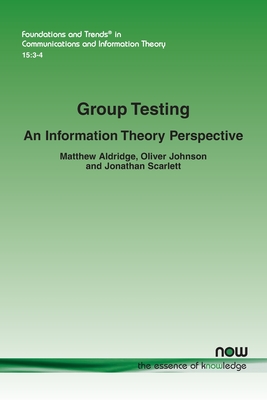
Group Testing: An Information Theory Perspective
| AUTHOR | Scarlett, Jonathan; Aldridge, Matthew; Johnson, Oliver |
| PUBLISHER | Now Publishers (12/05/2019) |
| PRODUCT TYPE | Paperback (Paperback) |
Description
Group testing emerged as an area for research from the need for the US Government to screen recruits in the second world war for syphilis. Obviously rather than testing each recruit, a more efficient method involving the minimal number of tests was required. The central problem of group testing is thus: Given a number of items and a number of defectives, how many tests are required to accurately discover the defective items, and how can this be achieved? Group testing has since found applications in medical testing, biology, telecommunications, information technology, data science, and more. The focus of this survey is on the non-adaptive setting of group testing. In this setting, the test pools are designed in advance enabling them to be implemented in parallel. The survey gives a comprehensive and thorough treatment of the subject from an information theoretic perspective. It covers several related developments: efficient algorithms with practical storage and computation requirements, achievability bounds for optimal decoding methods, and algorithm-independent converse bounds. It assesses the theoretical guarantees not only in terms of scaling laws, but also in terms of the constant factors, leading to the notion of the rate of group testing, indicating the amount of information learned per test. Considering both noiseless and noisy settings, it identifies several regimes where existing algorithms are provably optimal or near-optimal, as well as regimes where there remains greater potential for improvement. This monograph is an accessible treatment of an important topic for researchers and students in Information Theory.
Show More
Product Format
Product Details
ISBN-13:
9781680835960
ISBN-10:
1680835963
Binding:
Paperback or Softback (Trade Paperback (Us))
Content Language:
English
More Product Details
Page Count:
208
Carton Quantity:
38
Product Dimensions:
6.14 x 0.44 x 9.21 inches
Weight:
0.66 pound(s)
Country of Origin:
US
Subject Information
BISAC Categories
Computers | Information Theory
Descriptions, Reviews, Etc.
publisher marketing
Group testing emerged as an area for research from the need for the US Government to screen recruits in the second world war for syphilis. Obviously rather than testing each recruit, a more efficient method involving the minimal number of tests was required. The central problem of group testing is thus: Given a number of items and a number of defectives, how many tests are required to accurately discover the defective items, and how can this be achieved? Group testing has since found applications in medical testing, biology, telecommunications, information technology, data science, and more. The focus of this survey is on the non-adaptive setting of group testing. In this setting, the test pools are designed in advance enabling them to be implemented in parallel. The survey gives a comprehensive and thorough treatment of the subject from an information theoretic perspective. It covers several related developments: efficient algorithms with practical storage and computation requirements, achievability bounds for optimal decoding methods, and algorithm-independent converse bounds. It assesses the theoretical guarantees not only in terms of scaling laws, but also in terms of the constant factors, leading to the notion of the rate of group testing, indicating the amount of information learned per test. Considering both noiseless and noisy settings, it identifies several regimes where existing algorithms are provably optimal or near-optimal, as well as regimes where there remains greater potential for improvement. This monograph is an accessible treatment of an important topic for researchers and students in Information Theory.
Show More
List Price $99.00
Your Price
$98.01