
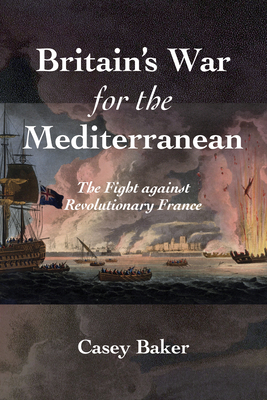
Britain's War for the Mediterranean: The Fight Against Revolutionary France
| AUTHOR | Baker, William Casey |
| PUBLISHER | Naval Institute Press (04/15/2024) |
| PRODUCT TYPE | Hardcover (Hardcover) |
Description
Britain's War for the Mediterranean provides a definitive study on British warmaking in the Mediterranean during the War of the First Coalition. It traces the origins of foreign and naval policies from the early eighteenth century to describe the duality of British affairs. These contradictions manifested themselves in the War of the First Coalition as Great Britain attempted to build consensus in the Mediterranean World while clinging to its power base of naval power and commerce. The book explores the decisions of individuals and the wider trends of the British political and naval system, honed over the course of the eighteenth century. In explaining war against Revolutionary France, the book follows the decisions of admirals, diplomats, and politicians in attempting to cobble together a coalition of Spanish, Austrian, Sardinian, and Neapolitan forces. This book also makes connections with the other theaters of war: The Austrian Netherlands and the Caribbean. Britain's War for the Mediterranean examines the internal working of the British government during the crisis of the French Revolution. It focuses on how politicians, diplomats, and military commanders formulated strategy for the Mediterranean theater. One of the major conclusions of this book is that the British government never spoke with one voice. Lacking synchronization in a changing conflict, the structure and conflicting objectives of each branch of the government failed to create a coherent plan to resist Republican expansion in the region. The book complicates the simplistic view of previous works on the weakness of allies and the naivete of the Pitt ministry, providing agency to diplomats and commanders across the region. The second major conclusion is that these conflicting objectives were firmly rooted in the experiences of the eighteenth century. British diplomacy, crippled in the aftermath of the American Revolution, saw the French Revolution as an opportunity to build consensus and a shared view of a British world. French aggression offered an opportunity to reclaim a position of influence lost over the course of the 1700s. In contrast, the trajectory of British foreign policy shaped the use of the Royal Navy in the eighteenth century. A trans-Atlantic force, a war in the Mediterranean forced British admirals to relearn the complicated nature of regional foreign policy. Diplomacy and naval power clashed over the conduct of the war - one rooted in foreign courts, the other in maritime coercion.
Show More
Product Format
Product Details
ISBN-13:
9781682479254
ISBN-10:
1682479250
Binding:
Hardback or Cased Book (Sewn)
Content Language:
English
More Product Details
Page Count:
360
Carton Quantity:
20
Product Dimensions:
6.10 x 1.10 x 9.10 inches
Weight:
1.35 pound(s)
Feature Codes:
Bibliography,
Index,
Price on Product,
Maps,
Illustrated
Country of Origin:
US
Subject Information
BISAC Categories
Political Science | International Relations - General
Political Science | Military - Naval
Political Science | Europe - Great Britain - Georgian Era (1714-1837)
Dewey Decimal:
327.410
Library of Congress Control Number:
2023046759
Descriptions, Reviews, Etc.
publisher marketing
Britain's War for the Mediterranean provides a definitive study on British warmaking in the Mediterranean during the War of the First Coalition. It traces the origins of foreign and naval policies from the early eighteenth century to describe the duality of British affairs. These contradictions manifested themselves in the War of the First Coalition as Great Britain attempted to build consensus in the Mediterranean World while clinging to its power base of naval power and commerce. The book explores the decisions of individuals and the wider trends of the British political and naval system, honed over the course of the eighteenth century. In explaining war against Revolutionary France, the book follows the decisions of admirals, diplomats, and politicians in attempting to cobble together a coalition of Spanish, Austrian, Sardinian, and Neapolitan forces. This book also makes connections with the other theaters of war: The Austrian Netherlands and the Caribbean. Britain's War for the Mediterranean examines the internal working of the British government during the crisis of the French Revolution. It focuses on how politicians, diplomats, and military commanders formulated strategy for the Mediterranean theater. One of the major conclusions of this book is that the British government never spoke with one voice. Lacking synchronization in a changing conflict, the structure and conflicting objectives of each branch of the government failed to create a coherent plan to resist Republican expansion in the region. The book complicates the simplistic view of previous works on the weakness of allies and the naivete of the Pitt ministry, providing agency to diplomats and commanders across the region. The second major conclusion is that these conflicting objectives were firmly rooted in the experiences of the eighteenth century. British diplomacy, crippled in the aftermath of the American Revolution, saw the French Revolution as an opportunity to build consensus and a shared view of a British world. French aggression offered an opportunity to reclaim a position of influence lost over the course of the 1700s. In contrast, the trajectory of British foreign policy shaped the use of the Royal Navy in the eighteenth century. A trans-Atlantic force, a war in the Mediterranean forced British admirals to relearn the complicated nature of regional foreign policy. Diplomacy and naval power clashed over the conduct of the war - one rooted in foreign courts, the other in maritime coercion.
Show More
List Price $36.00
Your Price
$35.64