
ISBN 9781722255428 is currently unpriced. Please contact us for pricing.
Available options are listed below:
Available options are listed below:
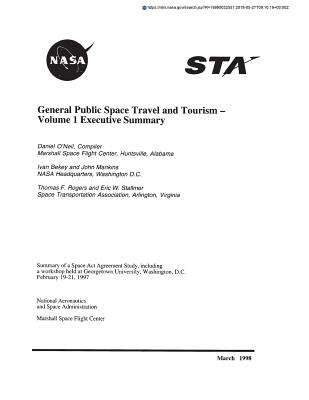
General Public Space Travel and Tourism. Volume 1; Executive Summary
| AUTHOR | Administration (Nasa), National Aeronaut |
| PUBLISHER | Createspace Independent Publishing Platform (07/03/2018) |
| PRODUCT TYPE | Paperback (Paperback) |
Description
Travel and tourism is one of the world's largest businesses. Its gross revenues exceed $400 billion per year in the U.S. alone, and it is our second largest employer. U.S. private sector business revenues in the space information area now approximate $10 billion per year, and are increasing rapidly. Not so in the human spaceflight area. After spending $100s of billions (1998 dollars) in public funds thereon, and continuing to spend over $5 billion per year, the government is still the only customer for human spaceflight goods and services. Serious and detailed consideration was first given to the possibility of space being opened up to trips by the general public three decades ago, and some initial attempts to do so were made a dozen years ago. But the difficulties were great and the Challenger disaster put an end to them. In recent years professional space tourism studies have been conducted in the United Kingdom, Germany and, especially, Japan. In the U.S., technological progress has been pronounced; we have had nearly a decade's experience in seeing our astronauts travel to-from low Earth orbit (LEO) safely, and we expect to commence assembly of a LEO space station housing a half-dozen people this year. Too, NASA and our space industry now have new and promising space transportation development programs underway, especially the X-33 and X-34 programs, and some related, further generation, basic technology development programs. And five private companies are also working on the design of new surface - LEO vehicles. The first professional space tourism market studies have been conducted in several countries in the past few years, especially in Japan and here. The U.S. study makes it clear that, conceptually, tens of millions of us would like to take a trip to space if we could do so with reasonable safety, comfort and reliability, and at an acceptable price. Initial businesses will address the desires of those willing to pay a greater price and accept a greater ris...
Show More
Product Format
Product Details
ISBN-13:
9781722255428
ISBN-10:
1722255420
Binding:
Paperback or Softback (Trade Paperback (Us))
Content Language:
English
More Product Details
Page Count:
42
Carton Quantity:
97
Product Dimensions:
8.50 x 0.09 x 11.00 inches
Weight:
0.27 pound(s)
Country of Origin:
US
Subject Information
BISAC Categories
Reference | Research
Descriptions, Reviews, Etc.
publisher marketing
Travel and tourism is one of the world's largest businesses. Its gross revenues exceed $400 billion per year in the U.S. alone, and it is our second largest employer. U.S. private sector business revenues in the space information area now approximate $10 billion per year, and are increasing rapidly. Not so in the human spaceflight area. After spending $100s of billions (1998 dollars) in public funds thereon, and continuing to spend over $5 billion per year, the government is still the only customer for human spaceflight goods and services. Serious and detailed consideration was first given to the possibility of space being opened up to trips by the general public three decades ago, and some initial attempts to do so were made a dozen years ago. But the difficulties were great and the Challenger disaster put an end to them. In recent years professional space tourism studies have been conducted in the United Kingdom, Germany and, especially, Japan. In the U.S., technological progress has been pronounced; we have had nearly a decade's experience in seeing our astronauts travel to-from low Earth orbit (LEO) safely, and we expect to commence assembly of a LEO space station housing a half-dozen people this year. Too, NASA and our space industry now have new and promising space transportation development programs underway, especially the X-33 and X-34 programs, and some related, further generation, basic technology development programs. And five private companies are also working on the design of new surface - LEO vehicles. The first professional space tourism market studies have been conducted in several countries in the past few years, especially in Japan and here. The U.S. study makes it clear that, conceptually, tens of millions of us would like to take a trip to space if we could do so with reasonable safety, comfort and reliability, and at an acceptable price. Initial businesses will address the desires of those willing to pay a greater price and accept a greater ris...
Show More