
ISBN 9781722912093 is currently unpriced. Please contact us for pricing.
Available options are listed below:
Available options are listed below:
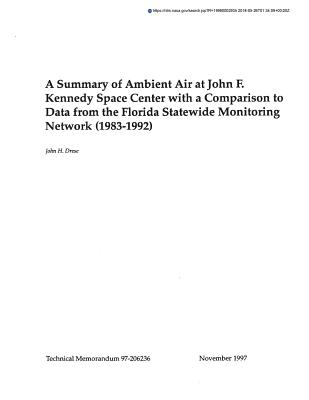
A Summary of Ambient Air at John F. Kennedy Space Center with a Comparison to Data from the Florida Statewide Monitoring Network (1983-1992)
| AUTHOR | Administration (Nasa), National Aeronaut |
| PUBLISHER | Createspace Independent Publishing Platform (07/17/2018) |
| PRODUCT TYPE | Paperback (Paperback) |
Description
The EPA criteria air pollutants were monitored at Kennedy Space Center (KSC) since 1983 to comply the prevention of significant deterioration requirements under the Clean Air Act amendments passed by Congress in 1977 and 1990. Monitoring results show that monthly maximum 24-hour total suspended particulates decreased from 144.6 micograms/cu m in 1988 to 73.0 micrograms/cu m in 1991 and increased to 149.3 micrograms/cu m in 1992. Inhalable particulates increased from 56.1 gg/M3 in 1983 to 131.4 micrograms/cu m in 1988, and then decreased to 38.5 micrograms/cu m in 1992. Sulfur dioxide monthly maximum 24-hour average concentrations decreased each year from 135.2 micrograms/cu m in 1983 to 33.8 micrograms/cu m in 1992. Nitrogen dioxide concentrations increased from 5.1 micrograms/cu m in 1983 to 5.9 micrograms/cu m in 1988, then decreased to 4.5 micrograms/cu m in 1992. Carbon monoxide annual average concentrations decreased from 6.2 micrograms/cu m in 1983 to 1.1 micrograms/cu m in 1988, and increased to 1.2 micrograms/cu m in 1992. Ozone maximum 1-hour concentrations increased from 98 parts per billion (ppb) in 1983 to 134 ppb in 1989, and then decreased to 80 ppb in 1992. Total annual rainfall ranged from 37.47 inches to 57.47 inches and shows a 6.6 percent increase over this same ten year period. Drese, John H. Kennedy Space Center AIR POLLUTION; CARBON MONOXIDE; SULFUR DIOXIDES; NITROGEN DIOXIDE; AIR QUALITY; GAS COMPOSITION; PREVENTION; PARTICULATES; OZONE...
Show More
Product Format
Product Details
ISBN-13:
9781722912093
ISBN-10:
172291209X
Binding:
Paperback or Softback (Trade Paperback (Us))
Content Language:
English
More Product Details
Page Count:
114
Carton Quantity:
35
Product Dimensions:
8.50 x 0.24 x 11.00 inches
Weight:
0.62 pound(s)
Country of Origin:
US
Subject Information
BISAC Categories
Reference | Research
Descriptions, Reviews, Etc.
publisher marketing
The EPA criteria air pollutants were monitored at Kennedy Space Center (KSC) since 1983 to comply the prevention of significant deterioration requirements under the Clean Air Act amendments passed by Congress in 1977 and 1990. Monitoring results show that monthly maximum 24-hour total suspended particulates decreased from 144.6 micograms/cu m in 1988 to 73.0 micrograms/cu m in 1991 and increased to 149.3 micrograms/cu m in 1992. Inhalable particulates increased from 56.1 gg/M3 in 1983 to 131.4 micrograms/cu m in 1988, and then decreased to 38.5 micrograms/cu m in 1992. Sulfur dioxide monthly maximum 24-hour average concentrations decreased each year from 135.2 micrograms/cu m in 1983 to 33.8 micrograms/cu m in 1992. Nitrogen dioxide concentrations increased from 5.1 micrograms/cu m in 1983 to 5.9 micrograms/cu m in 1988, then decreased to 4.5 micrograms/cu m in 1992. Carbon monoxide annual average concentrations decreased from 6.2 micrograms/cu m in 1983 to 1.1 micrograms/cu m in 1988, and increased to 1.2 micrograms/cu m in 1992. Ozone maximum 1-hour concentrations increased from 98 parts per billion (ppb) in 1983 to 134 ppb in 1989, and then decreased to 80 ppb in 1992. Total annual rainfall ranged from 37.47 inches to 57.47 inches and shows a 6.6 percent increase over this same ten year period. Drese, John H. Kennedy Space Center AIR POLLUTION; CARBON MONOXIDE; SULFUR DIOXIDES; NITROGEN DIOXIDE; AIR QUALITY; GAS COMPOSITION; PREVENTION; PARTICULATES; OZONE...
Show More