
ISBN 9781722914295 is currently unpriced. Please contact us for pricing.
Available options are listed below:
Available options are listed below:
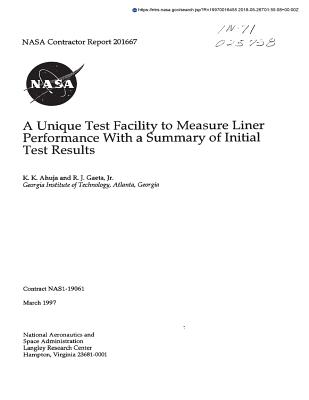
A Unique Test Facility to Measure Liner Performance with a Summary of Initial Test Results
| AUTHOR | Administration (Nasa), National Aeronaut |
| PUBLISHER | Createspace Independent Publishing Platform (07/17/2018) |
| PRODUCT TYPE | Paperback (Paperback) |
Description
A very ambitious study was initiated to obtain detailed acoustic and flow data with and without a liner in a duct containing a mean flow so that available theoretical models of duct liners can be validated. A unique flow-duct facility equipped with a sound source, liner box, flush-walled microphones, traversable microphones and traversable pressure and temperature probes was built. A unique set of instrumentation boxes equipped with computer controlled traverses were designed and built that allowed measurements of Mach number, temperature, SPLs and phases in two planes upstream of a liner section and two planes downstream at a large number of measurement points. Each pair of planes provided acoustic pressure gradients for use in estimating the particle velocities. Specially-built microphone probes were employed to make measurements in the presence of the flow. A microphone traverse was also designed to measure the distribution of SPLs and phases from the beginning of the liner to its end along the duct axis. All measurements were made with the help of cross-correlation techniques to reject flow noise and/or other obtrusive noise, if any. The facility was designed for future use at temperatures as high as 1500 F. In order to validate 2-D models in the presence of mean flow, the flow duct was equipped with a device to modify boundary layer flow on the smaller sides of a rectangular duct to simulate 2-D flow. A massive amount of data was acquired for use in validating duct liner models and will be provided to NASA in an electronic form. It was found that the sound in the plane-wave regime is well behaved within the duct and the results are repeatable from one run to another. At the higher frequencies corresponding to the higher-order modes, the SPLs within a duct are not repeatable from run to run. In fact, when two or more modes have the same frequency (i.e., for the degenerate modes), the SPLs in the duct varied between 2 dB to 12 dB from run to run. This made the ca...
Show More
Product Format
Product Details
ISBN-13:
9781722914295
ISBN-10:
1722914297
Binding:
Paperback or Softback (Trade Paperback (Us))
Content Language:
English
More Product Details
Page Count:
136
Carton Quantity:
29
Product Dimensions:
8.50 x 0.29 x 11.00 inches
Weight:
0.73 pound(s)
Country of Origin:
US
Subject Information
BISAC Categories
Reference | Research
Descriptions, Reviews, Etc.
publisher marketing
A very ambitious study was initiated to obtain detailed acoustic and flow data with and without a liner in a duct containing a mean flow so that available theoretical models of duct liners can be validated. A unique flow-duct facility equipped with a sound source, liner box, flush-walled microphones, traversable microphones and traversable pressure and temperature probes was built. A unique set of instrumentation boxes equipped with computer controlled traverses were designed and built that allowed measurements of Mach number, temperature, SPLs and phases in two planes upstream of a liner section and two planes downstream at a large number of measurement points. Each pair of planes provided acoustic pressure gradients for use in estimating the particle velocities. Specially-built microphone probes were employed to make measurements in the presence of the flow. A microphone traverse was also designed to measure the distribution of SPLs and phases from the beginning of the liner to its end along the duct axis. All measurements were made with the help of cross-correlation techniques to reject flow noise and/or other obtrusive noise, if any. The facility was designed for future use at temperatures as high as 1500 F. In order to validate 2-D models in the presence of mean flow, the flow duct was equipped with a device to modify boundary layer flow on the smaller sides of a rectangular duct to simulate 2-D flow. A massive amount of data was acquired for use in validating duct liner models and will be provided to NASA in an electronic form. It was found that the sound in the plane-wave regime is well behaved within the duct and the results are repeatable from one run to another. At the higher frequencies corresponding to the higher-order modes, the SPLs within a duct are not repeatable from run to run. In fact, when two or more modes have the same frequency (i.e., for the degenerate modes), the SPLs in the duct varied between 2 dB to 12 dB from run to run. This made the ca...
Show More