
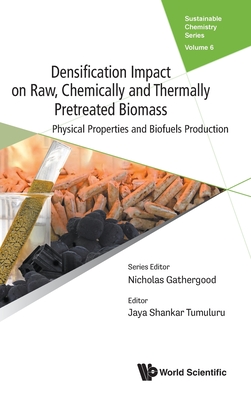
Densification Impact on Raw, Chemically and Thermally Pretreated Biomass: Physical Properties and Biofuels Production
| AUTHOR | Tumuluru, Jaya Shankar; Jaya Shankar Tumuluru; Tumuluru, Jaya Shankar et al. |
| PUBLISHER | World Scientific Publishing Europe Ltd (06/28/2023) |
| PRODUCT TYPE | Hardcover (Hardcover) |
Description
First-generation ethanol plants did not have many operational challenges as the feedstocks (e.g., corn) used for fuel production are dense, stable, storable, and shippable commodity-type products with fewer conversion challenges. These feedstock properties led the first-generation large-scale biorefineries to grow exponentially. In the second-generation biofuels, the feedstocks used are agricultural and forest residues, dedicated energy crops, industrial wastes, and municipal solid waste. When the industry tested these feedstocks for biofuel production, they faced flowability, storage, transportation, and conversion issues. One way to overcome some of the feeding, handling, transportation, and variable moisture challenges is to densify the biomass. Pellet mills and briquette presses are commonly used to produce densified products. The densified products have uniform size, shape, higher bulk density, and better downstream conversion performance. Also, the densified products are aerobically stable and can be stored for longer durations without any loss in quality.This book's focus is on understanding how the densification process variables, biomass types and their blends, mechanical preprocessing, and thermal and chemical pretreatment methods impact the quality of the densified products produced for biofuel production. Finally, the book also explores the conversion performance of densified biomass for biofuel production.
Show More
Product Format
Product Details
ISBN-13:
9781800613782
ISBN-10:
1800613784
Binding:
Hardback or Cased Book (Sewn)
Content Language:
English
More Product Details
Page Count:
348
Carton Quantity:
20
Product Dimensions:
6.00 x 0.81 x 9.00 inches
Weight:
1.39 pound(s)
Feature Codes:
Bibliography,
Index,
Illustrated
Country of Origin:
SG
Subject Information
BISAC Categories
Technology & Engineering | Power Resources - Fossil Fuels
Technology & Engineering | Animals - Wildlife
Dewey Decimal:
333.953
Library of Congress Control Number:
2022058158
Descriptions, Reviews, Etc.
publisher marketing
First-generation ethanol plants did not have many operational challenges as the feedstocks (e.g., corn) used for fuel production are dense, stable, storable, and shippable commodity-type products with fewer conversion challenges. These feedstock properties led the first-generation large-scale biorefineries to grow exponentially. In the second-generation biofuels, the feedstocks used are agricultural and forest residues, dedicated energy crops, industrial wastes, and municipal solid waste. When the industry tested these feedstocks for biofuel production, they faced flowability, storage, transportation, and conversion issues. One way to overcome some of the feeding, handling, transportation, and variable moisture challenges is to densify the biomass. Pellet mills and briquette presses are commonly used to produce densified products. The densified products have uniform size, shape, higher bulk density, and better downstream conversion performance. Also, the densified products are aerobically stable and can be stored for longer durations without any loss in quality.This book's focus is on understanding how the densification process variables, biomass types and their blends, mechanical preprocessing, and thermal and chemical pretreatment methods impact the quality of the densified products produced for biofuel production. Finally, the book also explores the conversion performance of densified biomass for biofuel production.
Show More
List Price $119.00
Your Price
$117.81