
Back to Search

Rapanese Spanish Series,: The Musical Method of Learning Spanish Series, [With Booklet]

AUTHOR D'Amours, Robert D.
PUBLISHER Rapanese (07/15/2003)
PRODUCT TYPE Audio (Analog Audio Cassette)

Description
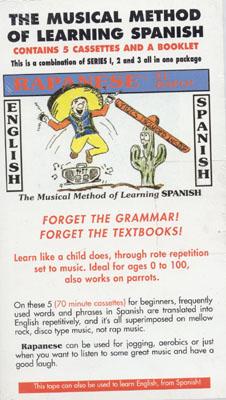
On these 5 (70 minute cassettes and book) for beginners, frequently used words and phrases in Spanish are translated into English repetitively, and it's all superimposed on really cool music, www.rapanese.com. It was put together by Mike D'Amours a French Canadian, ex-disc jockey, foreign language teacher. Children learn through rote repetition, (nursery rhymes). Adult's can learn this way also, but they already have a language. ONE NEEDS TO CONTINUOUSLY RELATE THE NEW LANGUAGE TO THE OLD LANGUAGE, IN THE BEGINNING. If this can be done without inducing boredom then people will keep listening, and learning will ensue. That is where RAPANESE comes in, (from the word JAPANESE when rap music was popular in 1989). You will think it is silly, you will laugh, you will cry but the main thing is YOU WILL KEEP LISTENING, and YOU WILL LEARN.
Show More
Product Format
Product Details
ISBN-13: 9781886447165
ISBN-10: 1886447160
Content Language: Spanish
More Product Details
Carton Quantity: 15
Product Dimensions: 5.20 x 1.27 x 8.87 inches
Weight: 0.68 pound(s)
Feature Codes: Ikids, Abridged
Country of Origin: US
Subject Information
BISAC Categories
Foreign Language Study | Spanish
Grade Level: 2nd Grade - 5th Grade
Dewey Decimal: NA
Descriptions, Reviews, Etc.
jacket back
THE RAPANESE METHOD

First the lyrics (each of 35 lessons on 5 seventy minute cassettes) are repeated slowly without music in both Spanish and English, just like conventional language tapes. Then the lyrics are repeated, sometimes sung, with AWESOME music. We repeat the Spanish and English words and phrases twice. YOU DO NOT GET BORED because your mind fixates on the music and you pick up the Spanish the way you pick up the words to your favorite song. YOUR MIND BECOMES BILINGUAL.

THE RESULT

You may be in a Mexican restaurant and hear "Disculpame". Right away you think "Excuse me". It becomes automatic. You actually think in English but speak in Spanish (in the beginning).

We have also discovered that when you learn this way (by cranking up the stereo and repeating along with the music) YOU HAVE NO ACCENT. What happens is that the repetition develops the proper muscles in your mouth which enable you to speak the language properly.

THE THEORY

Children learn through rote repetition, (nursery rhymes). Adult's can learn this way also, but they already have a language. ONE NEEDS TO CONTINUOUSLY RELATE THE NEW LANGUAGE TO THE OLD LANGUAGE, IN THE BEGINNING. If this can be done without inducing boredom then people will keep listening, and learning will ensue. That is where RAPANESE comes in, (from the word JAPANESE when rap music was popular in 1989). You will think it is silly, you will laugh, you will cry but the main thing is YOU WILL KEEP LISTENING, and YOU WILL LEARN.

HISTORY OF RAPANESE

Rapanese was created by a French Canadian, ex-disc jockey, school teacher, Mike D'Amours. He started using Rapanese in his classroom of 25 students in 1989 to teach Japanese. By 1991 theKelowna Secondary School, B.C. Canada, had to hire a second teacher to cope with the five fold increase in demand. Since 1994 he has used Rapanese to teach Spanish with the same incredible results.

Show More
publisher marketing
On these 5 (70 minute cassettes and book) for beginners, frequently used words and phrases in Spanish are translated into English repetitively, and it's all superimposed on really cool music, www.rapanese.com. It was put together by Mike D'Amours a French Canadian, ex-disc jockey, foreign language teacher. Children learn through rote repetition, (nursery rhymes). Adult's can learn this way also, but they already have a language. ONE NEEDS TO CONTINUOUSLY RELATE THE NEW LANGUAGE TO THE OLD LANGUAGE, IN THE BEGINNING. If this can be done without inducing boredom then people will keep listening, and learning will ensue. That is where RAPANESE comes in, (from the word JAPANESE when rap music was popular in 1989). You will think it is silly, you will laugh, you will cry but the main thing is YOU WILL KEEP LISTENING, and YOU WILL LEARN.
Show More
List Price $43.00
Your Price  $42.57
Audio