
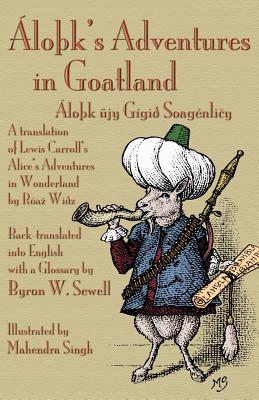
ÁloÞk's Adventures in Goatland: (ÁloÞk üjy Gígið Soagénli?y): A Translation of Lewis Carroll's Alice's Adventures in Wonderland by Róaz Wiðz, Bac
| AUTHOR | Sewell, Byron W.; Singh, Mahendra; Everson, Michael |
| PUBLISHER | Evertype (09/21/2011) |
| PRODUCT TYPE | Paperback (Paperback) |
Description
R az Wi z (1882-1937), the locally-admired though otherwise little-known Zumorgian translator, spent seventeen years of his miserable life (when he wasn't tending to his beloved goats) translating Lewis Carroll's classic "Alice's Adventures in Wonderland" into Zumorig nflit and transposing it into Ŋ ǧian culture. Sadly, Ŋ ǧ was swallowed up by the Soviet Union in 1947. Most of its citizens were either purged (lined up and summarily shot when they refused to combine their goats into a communal herd) or transported to the Gulag for political re-education and attitude adjustment. All cultural artifacts were systematically destroyed and most Zumorig nflit books were burned as part of the Soviet effort to obliterate Ŋ ǧ, along with any memory of it. The only known present-day Ŋ ǧian survivors of The Great Ŋ ǧ Purge (other than any possible survivors of the Gulag, whose descendants might conceivably live in Siberia) are now toothless old women, whose parents fled with them as infants from Ŋ ǧ to Transjordan the night of the purge. Today they live (if you can call it that) in a squalid refugee camp on the desert outskirts of Amman surrounded by very unhappy and angry displaced Palestinians. Some of these Ŋ ǧian refugees are still able to speak a little Zumorig nflit, though few of them can read it. For those interested in such esoteric things, " lo k jy G gi Soag nličy" was first published by the Itadab kan Press in the capital city of Sprutničovyurt in 1919. The city, which was mistakenly thought to be a German forward supply area, was literally flattened and burned to the ground by Royal Air Force saturation bombing in 1943, and all that remains of it are a few remnants of the ancient Palace's foundations and a gigantic reinforced concrete statue of Joseph Stalin, whose face has been shattered by what was probably machine gun target practice. The original story has here been updated to modern times, as if this strange, harsh, and dangerous land still existed in the modern world. It doesn't, except in my imagination and that of Mahendra Singh, whose heart swells with the Song of the Goat. -- Byron W. Sewell
Show More
Product Format
Product Details
ISBN-13:
9781904808763
ISBN-10:
190480876X
Binding:
Paperback or Softback (Trade Paperback (Us))
Content Language:
English
More Product Details
Page Count:
140
Carton Quantity:
58
Product Dimensions:
5.50 x 0.33 x 8.50 inches
Weight:
0.41 pound(s)
Feature Codes:
Illustrated
Country of Origin:
US
Subject Information
BISAC Categories
Humor | Form - Parodies
Grade Level:
3rd Grade
- 7th Grade
Dewey Decimal:
FIC
Library of Congress Control Number:
2012392504
Descriptions, Reviews, Etc.
annotation
The original story has here been updated to modern times, as if this strange, harsh, and dangerous land still existed in the modern world.
Show More
publisher marketing
R az Wi z (1882-1937), the locally-admired though otherwise little-known Zumorgian translator, spent seventeen years of his miserable life (when he wasn't tending to his beloved goats) translating Lewis Carroll's classic "Alice's Adventures in Wonderland" into Zumorig nflit and transposing it into Ŋ ǧian culture. Sadly, Ŋ ǧ was swallowed up by the Soviet Union in 1947. Most of its citizens were either purged (lined up and summarily shot when they refused to combine their goats into a communal herd) or transported to the Gulag for political re-education and attitude adjustment. All cultural artifacts were systematically destroyed and most Zumorig nflit books were burned as part of the Soviet effort to obliterate Ŋ ǧ, along with any memory of it. The only known present-day Ŋ ǧian survivors of The Great Ŋ ǧ Purge (other than any possible survivors of the Gulag, whose descendants might conceivably live in Siberia) are now toothless old women, whose parents fled with them as infants from Ŋ ǧ to Transjordan the night of the purge. Today they live (if you can call it that) in a squalid refugee camp on the desert outskirts of Amman surrounded by very unhappy and angry displaced Palestinians. Some of these Ŋ ǧian refugees are still able to speak a little Zumorig nflit, though few of them can read it. For those interested in such esoteric things, " lo k jy G gi Soag nličy" was first published by the Itadab kan Press in the capital city of Sprutničovyurt in 1919. The city, which was mistakenly thought to be a German forward supply area, was literally flattened and burned to the ground by Royal Air Force saturation bombing in 1943, and all that remains of it are a few remnants of the ancient Palace's foundations and a gigantic reinforced concrete statue of Joseph Stalin, whose face has been shattered by what was probably machine gun target practice. The original story has here been updated to modern times, as if this strange, harsh, and dangerous land still existed in the modern world. It doesn't, except in my imagination and that of Mahendra Singh, whose heart swells with the Song of the Goat. -- Byron W. Sewell
Show More
Illustrator:
Singh, Mahendra
MAHENDRA SINGH is a freelance illustrator whose Melville House illustrated edition of "The Hunting of the Snark" was praised by "Library Journal, The New Yorker", Salon.com, and Shelf Awareness.
Show More
List Price $15.95
Your Price
$15.79