
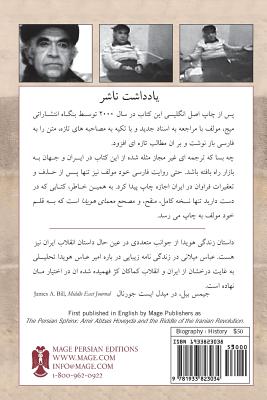
The Persian Sphinx (in Persian)
| AUTHOR | Milani, Abbas |
| PUBLISHER | Mage Publishers (05/01/2006) |
| PRODUCT TYPE | Paperback (Paperback) |
Description
Who lost Iran? How and why did a country, never richer, never more educated, its women never more liberated erupt in a fundamentalist revolution? the answer can be found in the enthralling life and tragic death of one man. Amir Abbas Hoveyda was a central figure in the historic struggle between modernity and tradition in Iran -- a struggle pitting Western cosmopolitanism against Persian isolationism, secularism against religious fundamentalism, and ultimately civil society and democracy against authoritarianism. Born in Tehran in 1919 to a family of solid middle class comforts and faded aristocratic roots, Hoveyda was an elegant, cultivated, well-read, and witty man, educated in Beirut, London, and Brussels. After entering the Iranian foreign service in 1942, he served in France, Germany, and Turkey, then returned to Iran in 1956 to join the National Iranian Oil Company. In 1965, the shah appointed him the country's prime minister. Hoveyda would serve faithfully in that post for thirteen years. Amir Abbas Hoveyda embodied the aspirations, the accomplishments and also the failures of a whole generation of Iranian technocrats -- mostly Western-trained -- who sought to free Iran from the travails of poverty and repression and guide it into the modern age. Hoveyda would be both a leader and a victim of that effort. On the eve of the Islamic Revolution, the shah, attempting to turn the rising tide of revolt by offering a scapegoat, ordered the prime minister's arrest. When the Pahlavi regime fell, Hoveyda chose not to flee, voluntarily surrendering to the new Islamic authorities. His hope was for a public trial; instead the infamous "Hanging Judge" presided over a secret and summary trial. In telling the story of Hoveyda's life, the author has not only laid bare the development of Iranian society during a pivotal period (1919 1978) but has also unearthed important new material on U.S.-Iranian relations. From 1957 onward, Amir Abbas Hoveyda played critical roles in dealing with U.S. foreign policy and fundamentalist Islamic opposition in Iran. Through careful use of hitherto-unexamined archival materials, unpublished letters, and personal journals, along with extensive interviews with more than a hundred of Hoveyda's relatives, friends, and foes, the author has brilliantly caught the pathos and passion of Hoveyda's life and times.
Show More
Product Format
Product Details
ISBN-13:
9781933823034
ISBN-10:
1933823038
Binding:
Paperback or Softback (Trade Paperback (Us))
Content Language:
Persian
More Product Details
Page Count:
564
Carton Quantity:
16
Product Dimensions:
6.00 x 1.26 x 9.00 inches
Weight:
1.80 pound(s)
Country of Origin:
US
Subject Information
BISAC Categories
Biography & Autobiography | Political
Dewey Decimal:
B
Descriptions, Reviews, Etc.
publisher marketing
Who lost Iran? How and why did a country, never richer, never more educated, its women never more liberated erupt in a fundamentalist revolution? the answer can be found in the enthralling life and tragic death of one man. Amir Abbas Hoveyda was a central figure in the historic struggle between modernity and tradition in Iran -- a struggle pitting Western cosmopolitanism against Persian isolationism, secularism against religious fundamentalism, and ultimately civil society and democracy against authoritarianism. Born in Tehran in 1919 to a family of solid middle class comforts and faded aristocratic roots, Hoveyda was an elegant, cultivated, well-read, and witty man, educated in Beirut, London, and Brussels. After entering the Iranian foreign service in 1942, he served in France, Germany, and Turkey, then returned to Iran in 1956 to join the National Iranian Oil Company. In 1965, the shah appointed him the country's prime minister. Hoveyda would serve faithfully in that post for thirteen years. Amir Abbas Hoveyda embodied the aspirations, the accomplishments and also the failures of a whole generation of Iranian technocrats -- mostly Western-trained -- who sought to free Iran from the travails of poverty and repression and guide it into the modern age. Hoveyda would be both a leader and a victim of that effort. On the eve of the Islamic Revolution, the shah, attempting to turn the rising tide of revolt by offering a scapegoat, ordered the prime minister's arrest. When the Pahlavi regime fell, Hoveyda chose not to flee, voluntarily surrendering to the new Islamic authorities. His hope was for a public trial; instead the infamous "Hanging Judge" presided over a secret and summary trial. In telling the story of Hoveyda's life, the author has not only laid bare the development of Iranian society during a pivotal period (1919 1978) but has also unearthed important new material on U.S.-Iranian relations. From 1957 onward, Amir Abbas Hoveyda played critical roles in dealing with U.S. foreign policy and fundamentalist Islamic opposition in Iran. Through careful use of hitherto-unexamined archival materials, unpublished letters, and personal journals, along with extensive interviews with more than a hundred of Hoveyda's relatives, friends, and foes, the author has brilliantly caught the pathos and passion of Hoveyda's life and times.
Show More
Author:
Milani, Abbas
Abbas Milani is a historian and author. He is the Director of Iranian Studies at Stanford University and co-director of the Iran Democracy Project at the Hoover Institution. He is the author of "The Shah". Milani has written for publications including The New York Times, The Wall Street Journal, and Forbes and has appeared on CNN, the BBC, and NPR, among others. A member of the board of directors of the Iranian Studies Group at MIT, the San Francisco Chronicle has said that Milani has the ear of Washington insiders. He lives in California.
Show More
List Price $50.00
Your Price
$49.50