
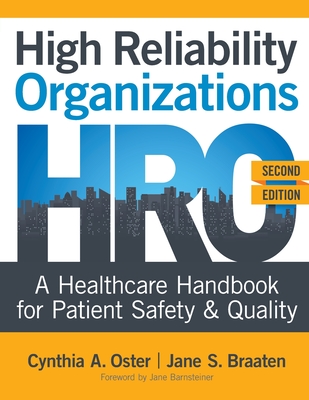
High Reliability Organizations, Second Edition: A Healthcare Handbook for Patient Safety & Quality
| AUTHOR | Braaten, Jane; Oster, Cindy Braaten, Jane; Braaten, Jane S. et al. |
| PUBLISHER | SIGMA Theta Tau International (11/30/2020) |
| PRODUCT TYPE | Paperback (Paperback) |
Awarded second place in the 2021 AJN Book of the Year Awards in Professional Issues!
Nurses represent the majority of healthcare workers and are on the front lines of delivery and provision of safe and effective care. As a result, nurses are ideally situated to drive the mission to achieve high reliability in healthcare. We expect the primary audience of this text to be frontline nursing staff, nurses in administration, quality and patient safety professionals, advanced practice nurses, and nurse educators. The healthcare professional who purchases this book will do so with the desire to learn more about the application of HRO principles to patient safety and quality problems. This book is unique in that it uses HRO principles as an organizing framework for practical application. The intent of the editors is to provide a quality and patient safety book that is useful to professionals doing the work of healthcare.
Healthcare professionals are constantly seeking practical tools and descriptions of practices that will improve and enhance patient safety and quality outcomes. High reliability is a current goal for hospitals, and the principles are sound. However, there is little in the literature that discusses how to apply the principles at the front lines of care to improve outcomes. This text addresses this gap by placing the need for high reliability concepts into our current climate in healthcare through illustrative discussion (theory and research) of each of the five concepts of HRO, along with a description of a current best practice and/or tool that applies to the model. The goal of this book is to stimulate organizations to embrace high reliability concepts while striving to improve the quality and safety of care delivered to patients and families. We all benefit from a safer healthcare environment.
The book is divided into eight parts:
- Part 1: This part provides background for the current safety and quality climate.
- Parts 2-6: These parts offer HRO concepts as a framework for the new model with examples.
- The first of these HRO concepts is that HROs have a preoccupation with failure.
- The second of these HRO concepts is that HROs restrain the impulse to view events through a single lens and are reluctant to simplify.
- The third HRO concept is that HROs demonstrate sensitivity to operations by making strong responses to weak signs.
- The fourth HRO concept is that HROs shift decision making away from formal authority and apply deference to expertise.
- The final HRO concept is that HROs have a commitment to resilience.
- Part 7: This part puts it all together and provides the reader with examples of how HRO concepts are assimilated into practice across the care continuum.
- Part 8: This part provides the reader with real-world examples of HRO principles employed in a variety of patient care areas.
Comprehensive Instructor's Guide and Student Workbook are available for this book.
Awarded second place in the 2021 AJN Book of the Year Awards in Professional Issues!
Nurses represent the majority of healthcare workers and are on the front lines of delivery and provision of safe and effective care. As a result, nurses are ideally situated to drive the mission to achieve high reliability in healthcare. We expect the primary audience of this text to be frontline nursing staff, nurses in administration, quality and patient safety professionals, advanced practice nurses, and nurse educators. The healthcare professional who purchases this book will do so with the desire to learn more about the application of HRO principles to patient safety and quality problems. This book is unique in that it uses HRO principles as an organizing framework for practical application. The intent of the editors is to provide a quality and patient safety book that is useful to professionals doing the work of healthcare.
Healthcare professionals are constantly seeking practical tools and descriptions of practices that will improve and enhance patient safety and quality outcomes. High reliability is a current goal for hospitals, and the principles are sound. However, there is little in the literature that discusses how to apply the principles at the front lines of care to improve outcomes. This text addresses this gap by placing the need for high reliability concepts into our current climate in healthcare through illustrative discussion (theory and research) of each of the five concepts of HRO, along with a description of a current best practice and/or tool that applies to the model. The goal of this book is to stimulate organizations to embrace high reliability concepts while striving to improve the quality and safety of care delivered to patients and families. We all benefit from a safer healthcare environment.
The book is divided into eight parts:
- Part 1: This part provides background for the current safety and quality climate.
- Parts 2-6: These parts offer HRO concepts as a framework for the new model with examples.
- The first of these HRO concepts is that HROs have a preoccupation with failure.
- The second of these HRO concepts is that HROs restrain the impulse to view events through a single lens and are reluctant to simplify.
- The third HRO concept is that HROs demonstrate sensitivity to operations by making strong responses to weak signs.
- The fourth HRO concept is that HROs shift decision making away from formal authority and apply deference to expertise.
- The final HRO concept is that HROs have a commitment to resilience.
- Part 7: This part puts it all together and provides the reader with examples of how HRO concepts are assimilated into practice across the care continuum.
- Part 8: This part provides the reader with real-world examples of HRO principles employed in a variety of patient care areas.
Comprehensive Instructor's Guide and Student Workbook are available for this book.