
ISBN 9781977081193 is currently unpriced. Please contact us for pricing.
Available options are listed below:
Available options are listed below:
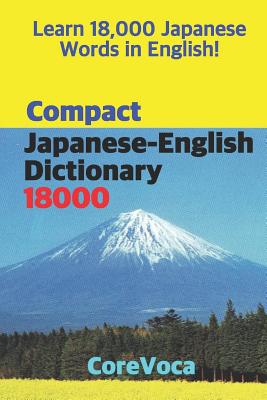
Compact Japanese-English Dictionary 18000: How to Learn Essential Japanese Vocabulary in English Alphabet for School, Exam, and Business
| AUTHOR | Kim, Taebum |
| PUBLISHER | Independently Published (02/02/2018) |
| PRODUCT TYPE | Paperback (Paperback) |
Description
This book is ideal for learners of Japanese as a second language who want to communicate more effectively and also for learners of English who know Japanese. This book lists approximately 18,000 core Japanese words with English equivalents. Main entries are in Romanized Japanese in boldface type alphabetically with Kana (Japanese alphabet) and Kanji (Chinese characters), if any. Next, in the same line, parts of speech label, and the entry's English equivalents with stressed syllables* in boldface type followed by standard American English pronunciation. Underline is used to discern Kanji in a word contains both Kana and Kanji. Sample] kūki 空気 n.] air eər] kūkino 空気の a.] airy eəri] kūkino yōna 空気のような a.] ethereal iθiəriəl] kūkio nuku 空気を抜く v.] deflate difleit] kukkī クッキー n.] cookie kuki] kyō'on 強音 n.] accent ksent] * Paperback version is also available at amazon.com
Show More
Product Format
Product Details
ISBN-13:
9781977081193
ISBN-10:
1977081193
Binding:
Paperback or Softback (Trade Paperback (Us))
Content Language:
English
More Product Details
Page Count:
276
Carton Quantity:
28
Product Dimensions:
5.98 x 0.58 x 9.02 inches
Weight:
0.82 pound(s)
Country of Origin:
US
Subject Information
BISAC Categories
Foreign Language Study | Japanese
Descriptions, Reviews, Etc.
publisher marketing
This book is ideal for learners of Japanese as a second language who want to communicate more effectively and also for learners of English who know Japanese. This book lists approximately 18,000 core Japanese words with English equivalents. Main entries are in Romanized Japanese in boldface type alphabetically with Kana (Japanese alphabet) and Kanji (Chinese characters), if any. Next, in the same line, parts of speech label, and the entry's English equivalents with stressed syllables* in boldface type followed by standard American English pronunciation. Underline is used to discern Kanji in a word contains both Kana and Kanji. Sample] kūki 空気 n.] air eər] kūkino 空気の a.] airy eəri] kūkino yōna 空気のような a.] ethereal iθiəriəl] kūkio nuku 空気を抜く v.] deflate difleit] kukkī クッキー n.] cookie kuki] kyō'on 強音 n.] accent ksent] * Paperback version is also available at amazon.com
Show More