
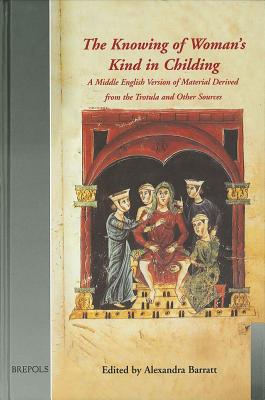
The Knowing of Woman's Kind in Childing: A Middle English Version of Material Derived from the Trotula and Other Sources
| AUTHOR | Barratt, A.; Barratt, Alexandra |
| PUBLISHER | Brepols Publishers (03/04/2002) |
| PRODUCT TYPE | Hardcover (Hardcover) |
Description
This study comprises a critical edition, using all the five extant MSS, of the most popular of the Middle English gynaecological texts deriving from the Latin Trotula-text. The Knowing of Women's Kind in Childing is a short fifteenth-century prose treatise which claims to be translated from Latin texts (or Latin and French, according to some manuscripts) that derive ultimately from the Greek. It has a unique importance as it was written by a woman, for a female audience, and on the subject of women. The text considers women's physical constitution, what makes them different from men (primarily the possession of a womb) and, in particular, the three types of problem that the womb causes. That it was written for a female audience is made explicit in the Prologue where the writer explains that he has translated this text out of French and Latin into English because literate women are more likely to read English than any other language and can then pass on the information it contains to illiterate women. More controversial must be the claim that this text was written by a woman. The text is a translation, no doubt by a man, but one of his ultimate sources was a text attributed to 'Trotula', in the Middle Ages believed to be the name of a midwife or gynaecologist from Salerno, who wrote extensively on women's ailments, childbirth and beauty care. Recent work shows that such a woman, probably named Trota, did exist and that she did write a gynaecological treatise, the Trotula or 'little Trota', which became closely associated with two other texts not by her. All three however became very popular and were widely disseminated under her name. Large sections of The Knowing of Woman's Kind come, via an Old French translation, from a version of the Liber de Sinthomatibus Mulierum (the Cum auctor), the first element in this Trotula ensemble.
Show More
Product Format
Product Details
ISBN-13:
9782503510736
ISBN-10:
2503510736
Binding:
Hardback or Cased Book (Sewn)
Content Language:
English
More Product Details
Page Count:
181
Carton Quantity:
0
Product Dimensions:
6.58 x 0.64 x 9.84 inches
Weight:
1.04 pound(s)
Country of Origin:
US
Subject Information
BISAC Categories
History | Europe - Medieval
History | Women's Studies
Dewey Decimal:
618
Descriptions, Reviews, Etc.
publisher marketing
This study comprises a critical edition, using all the five extant MSS, of the most popular of the Middle English gynaecological texts deriving from the Latin Trotula-text. The Knowing of Women's Kind in Childing is a short fifteenth-century prose treatise which claims to be translated from Latin texts (or Latin and French, according to some manuscripts) that derive ultimately from the Greek. It has a unique importance as it was written by a woman, for a female audience, and on the subject of women. The text considers women's physical constitution, what makes them different from men (primarily the possession of a womb) and, in particular, the three types of problem that the womb causes. That it was written for a female audience is made explicit in the Prologue where the writer explains that he has translated this text out of French and Latin into English because literate women are more likely to read English than any other language and can then pass on the information it contains to illiterate women. More controversial must be the claim that this text was written by a woman. The text is a translation, no doubt by a man, but one of his ultimate sources was a text attributed to 'Trotula', in the Middle Ages believed to be the name of a midwife or gynaecologist from Salerno, who wrote extensively on women's ailments, childbirth and beauty care. Recent work shows that such a woman, probably named Trota, did exist and that she did write a gynaecological treatise, the Trotula or 'little Trota', which became closely associated with two other texts not by her. All three however became very popular and were widely disseminated under her name. Large sections of The Knowing of Woman's Kind come, via an Old French translation, from a version of the Liber de Sinthomatibus Mulierum (the Cum auctor), the first element in this Trotula ensemble.
Show More
Your Price
$56.43