
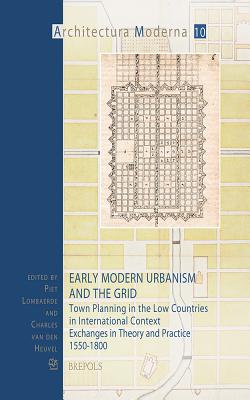
Early Modern Urbanism and the Grid: Town Planning in the Low Countries in International Context. Exchanges in Theory and Practice 1550-1800
| PUBLISHER | Brepols Publishers (08/31/2011) |
| PRODUCT TYPE | Paperback (Paperback) |
Description
From the late sixteenth century until around 1800, new ideas and practices of urban planningand the implementation of public buildings, water works and fortifications from the Low Countrieswere disseminated across Europe and America. Engineers, mathematicians and other scientistsin the Low Countries applied methods of design and land surveying that were gradually assimilated and often modified following exchanges within local practice. In some cases, models were projected onto the existing situation. This phenomenon of disseminating and exchanging theoretical models and practical methods between the Low Countries, Europe and its colonies during this period developed into a new Early Modern Urbanism movement within the Western World. Grid-like plans figured prominently in these processes of dissemination and exchange. In the Low Countries, grid-like structures allowed a comprehensive approach to a multitude of complex problems in urban planning (for example, the connection of canals, streets and fortifications) in parts of existing towns, as well as in city extensions and ex novo cities. Moreover, the experimental approaches in Antwerp and other urban laboratories resulted in new theories on town planning and fortification as well. Given the distinct cultures of the Catholic Spanish Southern Netherlands and the Republican, Dutch Calvinist Northern Netherlands, the Low Countries provide an excellent case for studying the identity of urban forms. Both engaged in enormous expansion overseas, and the simultaneous exchange of practices between the southern and northern parts of the Low Countries lead to the combination of identities. In this new volume in the Architectura Moderna series, various scholars examine the dissemination of practical methods and theoretical models of urban planning from the Northern and Southern Low Countries, in addition to exchanges with local practices in Northern and Central Europe and in the New World.
Show More
Product Format
Product Details
ISBN-13:
9782503540733
ISBN-10:
2503540732
Binding:
Paperback or Softback (Trade Paperback (Us))
Content Language:
English
More Product Details
Page Count:
272
Carton Quantity:
1
Product Dimensions:
8.70 x 0.60 x 10.90 inches
Weight:
2.05 pound(s)
Country of Origin:
US
Subject Information
BISAC Categories
History | Europe - Renaissance
History | Urban & Land Use Planning
History | Housing & Urban Development
Dewey Decimal:
711.41
Library of Congress Control Number:
2012387018
Descriptions, Reviews, Etc.
publisher marketing
From the late sixteenth century until around 1800, new ideas and practices of urban planningand the implementation of public buildings, water works and fortifications from the Low Countrieswere disseminated across Europe and America. Engineers, mathematicians and other scientistsin the Low Countries applied methods of design and land surveying that were gradually assimilated and often modified following exchanges within local practice. In some cases, models were projected onto the existing situation. This phenomenon of disseminating and exchanging theoretical models and practical methods between the Low Countries, Europe and its colonies during this period developed into a new Early Modern Urbanism movement within the Western World. Grid-like plans figured prominently in these processes of dissemination and exchange. In the Low Countries, grid-like structures allowed a comprehensive approach to a multitude of complex problems in urban planning (for example, the connection of canals, streets and fortifications) in parts of existing towns, as well as in city extensions and ex novo cities. Moreover, the experimental approaches in Antwerp and other urban laboratories resulted in new theories on town planning and fortification as well. Given the distinct cultures of the Catholic Spanish Southern Netherlands and the Republican, Dutch Calvinist Northern Netherlands, the Low Countries provide an excellent case for studying the identity of urban forms. Both engaged in enormous expansion overseas, and the simultaneous exchange of practices between the southern and northern parts of the Low Countries lead to the combination of identities. In this new volume in the Architectura Moderna series, various scholars examine the dissemination of practical methods and theoretical models of urban planning from the Northern and Southern Low Countries, in addition to exchanges with local practices in Northern and Central Europe and in the New World.
Show More
Your Price
$94.05