
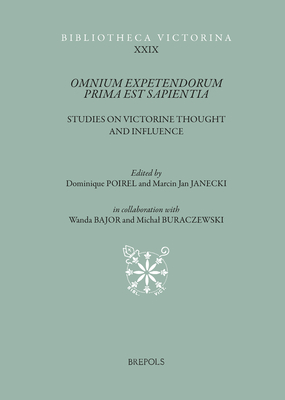
Omnium Expetendorum Prima Est Sapientia: Studies on Victorine Thought and Influence
| PUBLISHER | Brepols Publishers (12/25/2021) |
| PRODUCT TYPE | Hardcover (Hardcover) |
Description
Founded at the beginning of the twelfth century on the outskirts of Paris, the Parisian school of Saint-Victor soon became an intellectual centre on a European scale: through the international recruitment of its masters, Hugh, Achard, Richard, Andrew, Godfrey, Thomas Gallus and many others; through the wide handwritten dissemination of their works, in particular those of Hugh and Richard; and finally through the extent of its doctrinal contribution to a common European culture, on a large number of points: the importance, before specializing, of acquiring a general culture according to an encyclopedic curriculum rooted in classical and patristic traditions; the need for a rigorous historical approach to biblical texts, open to rabbinic exegesis, before moving on to their allegorical or moral interpretation; a contagious interest in the writings and thought, hitherto largely neglected, of the pseudo-Dionysius Areopagita; a major contribution to the constitution of a theological discipline, distinct from both exegesis and philosophy; an effort to reconcile rigour in doctrinal speculation, fervour in spiritual life and psychological finesse in the analysis of contemplation and its stages. In short, a curiosity for all fields of knowledge and, at the same time, an effort to unify them into a universal and unified wisdom explains the role, direct or indirect, played by the masters of Saint-Victor in the constitution of a common European thought, at the time of medieval universities and beyond. The Book gathers new studies on original sources concerning Hugh of St. Victor, as the intellectual founder or the Victorine school; several of his Victorine brothers and disciples: Richard, Achard, Andrew, Godfrey, Absalon, up to late and little known Victorine masters as Pierre Leduc and Henri le Boulangier, at the time of the Great Schism (with critical edition of inedited texts); their influences on twelfth century texts as Ysagoge in theologiam or Speculum Ecclesiae, on Franciscan authors including Antony of Padua, Bonaventure, Rudolf of Biberach, and Duns Scotus, on romance literature of troubadours, on Carmelite authors of the sixteenth centruy and - a still uncharted territory - on Polish culture from Middle Ages to contemporary times.
Show More
Product Format
Product Details
ISBN-13:
9782503596501
ISBN-10:
2503596509
Binding:
Hardback or Cased Book (Sewn)
Content Language:
French
More Product Details
Page Count:
550
Carton Quantity:
1
Product Dimensions:
7.32 x 1.50 x 10.24 inches
Weight:
2.75 pound(s)
Feature Codes:
Multi-Lingual
Country of Origin:
GB
Subject Information
BISAC Categories
Education | History
Education | Europe - France
Education | Europe - Medieval
Descriptions, Reviews, Etc.
publisher marketing
Founded at the beginning of the twelfth century on the outskirts of Paris, the Parisian school of Saint-Victor soon became an intellectual centre on a European scale: through the international recruitment of its masters, Hugh, Achard, Richard, Andrew, Godfrey, Thomas Gallus and many others; through the wide handwritten dissemination of their works, in particular those of Hugh and Richard; and finally through the extent of its doctrinal contribution to a common European culture, on a large number of points: the importance, before specializing, of acquiring a general culture according to an encyclopedic curriculum rooted in classical and patristic traditions; the need for a rigorous historical approach to biblical texts, open to rabbinic exegesis, before moving on to their allegorical or moral interpretation; a contagious interest in the writings and thought, hitherto largely neglected, of the pseudo-Dionysius Areopagita; a major contribution to the constitution of a theological discipline, distinct from both exegesis and philosophy; an effort to reconcile rigour in doctrinal speculation, fervour in spiritual life and psychological finesse in the analysis of contemplation and its stages. In short, a curiosity for all fields of knowledge and, at the same time, an effort to unify them into a universal and unified wisdom explains the role, direct or indirect, played by the masters of Saint-Victor in the constitution of a common European thought, at the time of medieval universities and beyond. The Book gathers new studies on original sources concerning Hugh of St. Victor, as the intellectual founder or the Victorine school; several of his Victorine brothers and disciples: Richard, Achard, Andrew, Godfrey, Absalon, up to late and little known Victorine masters as Pierre Leduc and Henri le Boulangier, at the time of the Great Schism (with critical edition of inedited texts); their influences on twelfth century texts as Ysagoge in theologiam or Speculum Ecclesiae, on Franciscan authors including Antony of Padua, Bonaventure, Rudolf of Biberach, and Duns Scotus, on romance literature of troubadours, on Carmelite authors of the sixteenth centruy and - a still uncharted territory - on Polish culture from Middle Ages to contemporary times.
Show More
Your Price
$148.50