
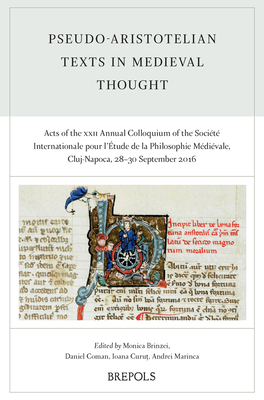
Pseudo-Aristotelian Texts in Medieval Thought: Acts of the XXII Annual Colloquium of the Societe Internationale Pour Letude de la Philosophie Medieval
| PUBLISHER | Brepols Publishers (12/07/2023) |
| PRODUCT TYPE | Hardcover (Hardcover) |
Description
The Philosopher, the Master of Those Who Know, was the dominant pagan authority in all four of the main traditions of medieval philosophy: Arabic, Greek, Hebrew, and Latin. Yet we now know that a number of works attributed to Aristotle were in fact spurious, authored by others who claimed to be, or whom others claimed to be, the Stagirite, for example, the Secretum secretorum, the Liber de causis, De mundo, De proprietatibus elementorum, De pomo, and De plantis. These writings strongly impacted medieval thought in various and fascinating ways, both in the original language, be it Arabic, Greek, Hebrew or Latin, and in translation. The mechanisms of their production, dissemination, and translation are themselves worthy of attention. Many of these works spawned commentary traditions of their own, parallel to those involving the classic texts of Peripatetic philosophy. Apparent contradictions between ideas expressed in these treatises and those found in what we consider to be authentic works, for instance ideas that appeared to derive more from the Academy than from the Lyceum, provoked questions about authenticity and about the possible evolution of Aristotle's thought. Finally, these texts were employed in one way or another in many genres of philosophical literature in the Middle Ages, including metaphysics, natural and moral philosophy, theology, and even more exotic disciplines like chiromancy and alchemy. This volume aims to shed new light on various aspects of the history of Pseudo-Aristotelian texts in the Middle Ages.
Show More
Product Format
Product Details
ISBN-13:
9782503606064
ISBN-10:
2503606067
Binding:
Hardback or Cased Book (Sewn)
Content Language:
German
More Product Details
Page Count:
382
Carton Quantity:
1
Weight:
3.24 pound(s)
Feature Codes:
Bilingual
Country of Origin:
US
Subject Information
BISAC Categories
Philosophy | History & Surveys - Ancient & Classical
Philosophy | History & Surveys - Medieval
Descriptions, Reviews, Etc.
publisher marketing
The Philosopher, the Master of Those Who Know, was the dominant pagan authority in all four of the main traditions of medieval philosophy: Arabic, Greek, Hebrew, and Latin. Yet we now know that a number of works attributed to Aristotle were in fact spurious, authored by others who claimed to be, or whom others claimed to be, the Stagirite, for example, the Secretum secretorum, the Liber de causis, De mundo, De proprietatibus elementorum, De pomo, and De plantis. These writings strongly impacted medieval thought in various and fascinating ways, both in the original language, be it Arabic, Greek, Hebrew or Latin, and in translation. The mechanisms of their production, dissemination, and translation are themselves worthy of attention. Many of these works spawned commentary traditions of their own, parallel to those involving the classic texts of Peripatetic philosophy. Apparent contradictions between ideas expressed in these treatises and those found in what we consider to be authentic works, for instance ideas that appeared to derive more from the Academy than from the Lyceum, provoked questions about authenticity and about the possible evolution of Aristotle's thought. Finally, these texts were employed in one way or another in many genres of philosophical literature in the Middle Ages, including metaphysics, natural and moral philosophy, theology, and even more exotic disciplines like chiromancy and alchemy. This volume aims to shed new light on various aspects of the history of Pseudo-Aristotelian texts in the Middle Ages.
Show More
Your Price
$87.12