
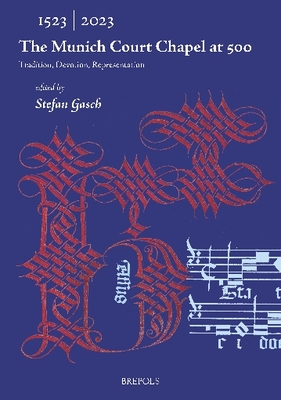
The Munich Court Chapel at 500: Tradition, Devotion, Representation
| PUBLISHER | Brepols Publishers (08/28/2025) |
| PRODUCT TYPE | Paperback (Paperback) |
Description
This collection of essays is the first to focus exclusively on the Wittelsbach court of Duke Wilhelm IV of Bavaria (1493-1550). The contributors argue for a deeper understanding of this duke's reign and acknowledge his crucial role in shaping the religious and cultural identity of the Duchy of Bavaria. By providing insights into the duke's cultural aspirations, the organisation of the court, musical sources, religious musical practice, and everyday working life, this book aims to: (1) situate the court of Wilhelm IV in the context of the religious and political upheavals of the early sixteenth century; (2) trace the development of the musical repertoire and personnel of the Bavarian court chapel between 1500 and 1550; and (3) critically assess the degree to which the Munich court could be considered 'modern' by re-evaluating the broader cultural, religious, and musical life of the court around 1520. The volume thus sheds light on the cultural ambitions of a duke who defined music and art as expressions of strategic elements that interwove tradition, devotion, and representation in a programme of governance based on humanist education-a duke whose foresight enabled the Munich court to quickly become one of the most prestigious and famous seats of power in the Holy Roman Empire.
Show More
Product Format
Product Details
ISBN-13:
9782503619064
ISBN-10:
2503619061
Binding:
Paperback or Softback (Trade Paperback (Us))
Content Language:
German
More Product Details
Page Count:
719
Carton Quantity:
1
Weight:
2.30 pound(s)
Feature Codes:
Bilingual
Country of Origin:
US
Subject Information
BISAC Categories
Unassigned | Europe - Germany
Unassigned | History & Criticism - General
Descriptions, Reviews, Etc.
publisher marketing
This collection of essays is the first to focus exclusively on the Wittelsbach court of Duke Wilhelm IV of Bavaria (1493-1550). The contributors argue for a deeper understanding of this duke's reign and acknowledge his crucial role in shaping the religious and cultural identity of the Duchy of Bavaria. By providing insights into the duke's cultural aspirations, the organisation of the court, musical sources, religious musical practice, and everyday working life, this book aims to: (1) situate the court of Wilhelm IV in the context of the religious and political upheavals of the early sixteenth century; (2) trace the development of the musical repertoire and personnel of the Bavarian court chapel between 1500 and 1550; and (3) critically assess the degree to which the Munich court could be considered 'modern' by re-evaluating the broader cultural, religious, and musical life of the court around 1520. The volume thus sheds light on the cultural ambitions of a duke who defined music and art as expressions of strategic elements that interwove tradition, devotion, and representation in a programme of governance based on humanist education-a duke whose foresight enabled the Munich court to quickly become one of the most prestigious and famous seats of power in the Holy Roman Empire.
Show More
Your Price
$155.43