
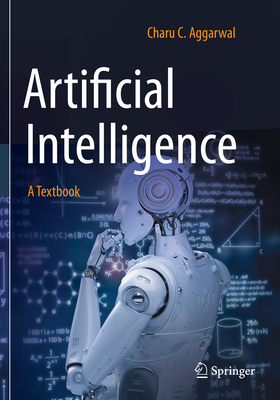
Artificial Intelligence: A Textbook
| AUTHOR | Aggarwal, Charu C. |
| PUBLISHER | Springer (07/18/2022) |
| PRODUCT TYPE | Paperback (Paperback) |
This textbook covers the broader field of artificial intelligence. The chapters for this textbook span within three categories:
- Deductive reasoning methods: These methods start with pre-defined hypotheses and reason with them in order to arrive at logically sound conclusions. The underlying methods include search and logic-based methods. These methods are discussed in Chapters 1through 5.
- Inductive Learning Methods: These methods start with examples and use statistical methods in order to arrive at hypotheses. Examples include regression modeling, support vector machines, neural networks, reinforcement learning, unsupervised learning, and probabilistic graphical models. These methods are discussed in Chapters 6 through 11.
- Integrating Reasoning and Learning: Chapters 11 and 12 discuss techniques for integrating reasoning and learning. Examples include the use of knowledge graphs and neuro-symbolic artificial intelligence.
The primary audience for this textbook are professors and advanced-level students in computer science. It is also possible to use this textbook for the mathematics requirements for an undergraduate data science course. Professionals working in this related field many also find this textbook useful as a reference.
This textbook covers the broader field of artificial intelligence. The chapters for this textbook span within three categories:
- Deductive reasoning methods: These methods start with pre-defined hypotheses and reason with them in order to arrive at logically sound conclusions. The underlying methods include search and logic-based methods. These methods are discussed in Chapters 1through 5.
- Inductive Learning Methods: These methods start with examples and use statistical methods in order to arrive at hypotheses. Examples include regression modeling, support vector machines, neural networks, reinforcement learning, unsupervised learning, and probabilistic graphical models. These methods are discussed in Chapters 6 through 11.
- Integrating Reasoning and Learning: Chapters 11 and 12 discuss techniques for integrating reasoning and learning. Examples include the use of knowledge graphs and neuro-symbolic artificial intelligence.
The primary audience for this textbook are professors and advanced-level students in computer science. It is also possible to use this textbook for the mathematics requirements for an undergraduate data science course. Professionals working in this related field many also find this textbook useful as a reference.
This textbook covers the broader field of artificial intelligence. The chapters for this textbook span within three categories:
- Deductive reasoning methods: These methods start with pre-defined hypotheses and reason with them in order to arrive at logically sound conclusions. The underlying methods include search and logic-based methods. These methods are discussed in Chapters 1through 5.
- Inductive Learning Methods: These methods start with examples and use statistical methods in order to arrive at hypotheses. Examples include regression modeling, support vector machines, neural networks, reinforcement learning, unsupervised learning, and probabilistic graphical models. These methods are discussed in Chapters 6 through 11.
- Integrating Reasoning and Learning: Chapters 11 and 12 discuss techniques for integrating reasoning and learning. Examples include the use of knowledge graphs and neuro-symbolic artificial intelligence.
The primary audience for this textbook are professors and advanced-level students in computer science. It is also possible to use this textbook for the mathematics requirements for an undergraduate data science course. Professionals working in this related field many also find this textbook useful as a reference.