
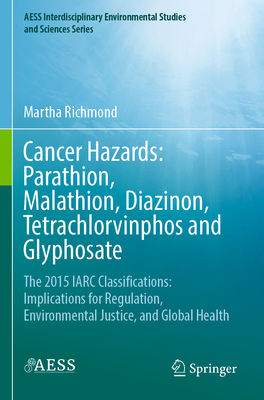
Cancer Hazards: Parathion, Malathion, Diazinon, Tetrachlorvinphos and Glyphosate: The 2015 IARC Classifications: Implications for Regulation, Environm
| AUTHOR | Richmond, Martha |
| PUBLISHER | Springer (02/28/2023) |
| PRODUCT TYPE | Paperback (Paperback) |
This book focuses on a monograph published in 2017 by the International Agency for Research on Cancer (IARC), an agency of the World Health Organization (WHO), discussing its carcinogen hazard classification of four pesticides: parathion, malathion, diazinon, and tetrachlorvinphos as well as the herbicide glyphosate.
The monograph provided a detailed discussion of considerations and conclusions made by a group of experts who met in 2015 to evaluate these compounds. Although not universally true, many of these substances, from the time of their commercial introduction to their present-day use, have spread significantly in the environment, affecting animals and plants in the larger ecosystem, the overall health of the environment, and human health.
This book develops each of these issues before turning to the IARC review process, both the general process and its evolution over time, and compound selection criteria and deliberations regarding the substances discussed in the 2017 monograph. Final book sections detail scientific and private sector reactions to and implications of the IARC classifications. Hazard identification is contrasted with various models of quantitative risk assessment. The last chapters highlight the importance of hazard identification for members of domestic and global underserved communities involved in farming and landscape work, where exposures may vary widely, are not well-regulated, and where health outcomes are often not carefully documented.
This book focuses on a monograph published in 2017 by the International Agency for Research on Cancer (IARC), an agency of the World Health Organization (WHO), discussing its carcinogen hazard classification of four pesticides: parathion, malathion, diazinon, and tetrachlorvinphos as well as the herbicide glyphosate.
The monograph provided a detailed discussion of considerations and conclusions made by a group of experts who met in 2015 to evaluate these compounds. Although not universally true, many of these substances, from the time of their commercial introduction to their present-day use, have spread significantly in the environment, affecting animals and plants in the larger ecosystem, the overall health of the environment, and human health.
This book develops each of these issues before turning to the IARC review process, both the general process and its evolution over time, and compound selection criteria and deliberations regarding the substancesdiscussed in the 2017 monograph. Final book sections detail scientific and private sector reactions to and implications of the IARC classifications. Hazard identification is contrasted with various models of quantitative risk assessment. The last chapters highlight the importance of hazard identification for members of domestic and global underserved communities involved in farming and landscape work, where exposures may vary widely, are not well-regulated, and where health outcomes are often not carefully documented.
This book focuses on a monograph published in 2017 by the International Agency for Research on Cancer (IARC), an agency of the World Health Organization (WHO), discussing its carcinogen hazard classification of four pesticides: parathion, malathion, diazinon, and tetrachlorvinphos as well as the herbicide glyphosate.
The monograph provided a detailed discussion of considerations and conclusions made by a group of experts who met in 2015 to evaluate these compounds. Although not universally true, many of these substances, from the time of their commercial introduction to their present-day use, have spread significantly in the environment, affecting animals and plants in the larger ecosystem, the overall health of the environment, and human health.
This book develops each of these issues before turning to the IARC review process, both the general process and its evolution over time, and compound selection criteria and deliberations regarding the substances discussed in the 2017 monograph. Final book sections detail scientific and private sector reactions to and implications of the IARC classifications. Hazard identification is contrasted with various models of quantitative risk assessment. The last chapters highlight the importance of hazard identification for members of domestic and global underserved communities involved in farming and landscape work, where exposures may vary widely, are not well-regulated, and where health outcomes are often not carefully documented.