
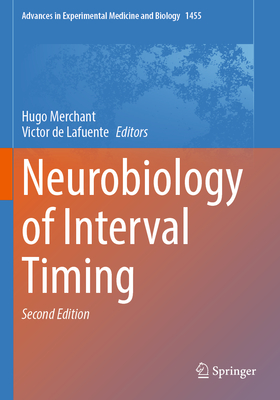
Neurobiology of Interval Timing
| PUBLISHER | Springer (06/27/2025) |
| PRODUCT TYPE | Paperback (Paperback) |
The study of how the brain processes time is becoming one of the most important topics in systems, cellular, computational, and cognitive neuroscience, as well as in the physiologic bases of music and language. During the last and current decade, interval timing has been intensively studied in humans and animals using increasingly sophisticated approaches. This new edition of the Neurobiology of Interval Timing integrates the current knowledge of animal behavior and human cognition of the passage of time in different behavioral contexts, including the perception and production of time intervals, as well as rhythmic activities. The chapters are written by the leading experts in the fields of psychophysics, functional imaging, systems neurophysiology, and musicology. The new edition features a complete updating of the content with many new chapters. The main updates are the remarkable advances in our understanding of the neural basis of temporal processing in monkeys, rodents, and humans. The notion is that the neural clock depends on the dynamics of neural populations in the motor system, and that this general internal time representation interacts with the sensory and cognitive systems depending on the timing requirements and the behavioral contingencies of a specific task. Also, this edition delineates a clearer distinction between interval-based and beat-based timing in humans.
The study of how the brain processes time is becoming one of the most important topics in systems, cellular, computational, and cognitive neuroscience, as well as in the physiologic bases of music and language. During the last and current decade, interval timing has been intensively studied in humans and animals using increasingly sophisticated approaches. This new edition of the Neurobiology of Interval Timing integrates the current knowledge of animal behavior and human cognition of the passage of time in different behavioral contexts, including the perception and production of time intervals, as well as rhythmic activities. The chapters are written by the leading experts in the fields of psychophysics, functional imaging, systems neurophysiology, and musicology. The new edition features a complete updating of the content with many new chapters. The main updates are the remarkable advances in our understanding of the neural basis of temporal processing in monkeys, rodents, and humans. The notion is that the neural clock depends on the dynamics of neural populations in the motor system, and that this general internal time representation interacts with the sensory and cognitive systems depending on the timing requirements and the behavioral contingencies of a specific task. Also, this edition delineates a clearer distinction between interval-based and beat-based timing in humans.
The study of how the brain processes time is becoming one of the most important topics in systems, cellular, computational, and cognitive neuroscience, as well as in the physiologic bases of music and language. During the last and current decade, interval timing has been intensively studied in humans and animals using increasingly sophisticated approaches. This new edition of the Neurobiology of Interval Timing integrates the current knowledge of animal behavior and human cognition of the passage of time in different behavioral contexts, including the perception and production of time intervals, as well as rhythmic activities. The chapters are written by the leading experts in the fields of psychophysics, functional imaging, systems neurophysiology, and musicology. The new edition features a complete updating of the content with many new chapters. The main updates are the remarkable advances in our understanding of the neural basis of temporal processing in monkeys, rodents, and humans. The notion is that the neural clock depends on the dynamics of neural populations in the motor system, and that this general internal time representation interacts with the sensory and cognitive systems depending on the timing requirements and the behavioral contingencies of a specific task. Also, this edition delineates a clearer distinction between interval-based and beat-based timing in humans.