
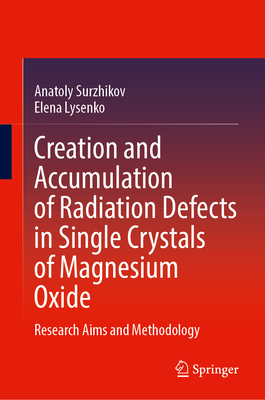
Creation and Accumulation of Radiation Defects in Single Crystals of Magnesium Oxide: Research Aims and Methodology
| AUTHOR | Surzhikov, Anatoly; Lysenko, Elena |
| PUBLISHER | Springer (06/05/2024) |
| PRODUCT TYPE | Hardcover (Hardcover) |
The range of problems that can be solved with the use of powerful radiation installations is determined: generation of nanosecond ultrahigh-frequency (microwave) pulses, collective acceleration of charged particles, the implementation of a controlled fusion reaction, and the creation of high-power lasers. In this edition, the questions posed for the SCM were solved using the example of single crystals of magnesium oxide. By the beginning of the authors' work, the structure of the color centers induced by radiation in magnesium oxide, the positions of the maxima of the optical absorption and luminescence bands, as well as the values of their half-widths and the temperature range of stability, were sufficiently established. There is practically no information about the location of internode ions in magnesium oxide crystals, and methods for their registration have not been worked out.
These data are particularly important since the efficiency of the accumulation of radiation defects depends to a certain extent on the efficiency of fixing displaced of in the crystal lattice. However, all studies confirming this point of view were carried out using low and medium levels of arousal. The effect of high absorbed radiation energy capacities on the formation and accumulation of radiation defects in magnesium oxide crystals has not been practically studied.
The range of problems that can be solved with the use of powerful radiation installations is determined: generation of nanosecond ultrahigh-frequency (microwave) pulses, collective acceleration of charged particles, the implementation of a controlled fusion reaction, and the creation of high-power lasers. In this edition, the questions posed for the SCM were solved using the example of single crystals of magnesium oxide. By the beginning of the authors' work, the structure of the color centers induced by radiation in magnesium oxide, the positions of the maxima of the optical absorption and luminescence bands, as well as the values of their half-widths and the temperature range of stability, were sufficiently established. There is practically no information about the location of internode ions in magnesium oxide crystals, and methods for their registration have not been worked out.
These data are particularly important since the efficiency of the accumulation of radiation defects depends to a certain extent on the efficiency of fixing displaced of in the crystal lattice. However, all studies confirming this point of view were carried out using low and medium levels of arousal. The effect of high absorbed radiation energy capacities on the formation and accumulation of radiation defects in magnesium oxide crystals has not been practically studied.
The range of problems that can be solved with the use of powerful radiation installations is determined: generation of nanosecond ultrahigh-frequency (microwave) pulses, collective acceleration of charged particles, the implementation of a controlled fusion reaction, and the creation of high-power lasers. In this edition, the questions posed for the SCM were solved using the example of single crystals of magnesium oxide. By the beginning of the authors' work, the structure of the color centers induced by radiation in magnesium oxide, the positions of the maxima of the optical absorption and luminescence bands, as well as the values of their half-widths and the temperature range of stability, were sufficiently established. There is practically no information about the location of internode ions in magnesium oxide crystals, and methods for their registration have not been worked out.
These data are particularly important since the efficiency of the accumulation of radiation defects depends to a certain extent on the efficiency of fixing displaced of in the crystal lattice. However, all studies confirming this point of view were carried out using low and medium levels of arousal. The effect of high absorbed radiation energy capacities on the formation and accumulation of radiation defects in magnesium oxide crystals has not been practically studied.