
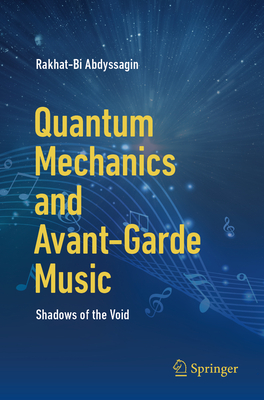
Quantum Mechanics and Avant-Garde Music: Shadows of the Void
| AUTHOR | Abdyssagin, Rakhat-Bi |
| PUBLISHER | Springer (09/24/2024) |
| PRODUCT TYPE | Paperback (Paperback) |
Explore the intriguing ties between Pauli's exclusion principle and Schoenberg's dodecaphony, and the echoes of Heisenberg's uncertainty principle in Stockhausen and Cage's compositions. This book delves into these connections, revealing the fusion of modern physics and avant-garde music. From philosophical musings on time to the transformation of algebra into musical notation, it uncovers the intersection of mathematics, physics, and music.
With meticulous research, the author demonstrates how quantum physics and relativity shaped both fields in the 20th century. Through historical anecdotes, he unveils the musical endeavors of physicists like Planck and Einstein, connecting their theories to contemporary musical techniques. Accessible to all readers, the text offers a fresh perspective on the convergence of science and art, serving as a bridge for scientists, musicians, and the curious alike. Whether you're new to physics or music, this book provides an illuminating journey into the interconnected realms of creativity and discovery.
"Fascinating details and anecdotes accompany this engaging account of the emergence of dramatic new ideas and forms in music over the centuries..."
David Politzer, winner of the 2004 Nobel Prize in Physics.
"A thought-provoking, stimulating, and highly original exploration of deep metaphorical links between music and physics...Highly recommended."
Prof. Ian Stewart FRS, author, What's the Use?
"An astonishing book!"
Tristan Murail, composer and co-creator of the "spectral" technique.
"Fascinating details and anecdotes accompany this engaging account of the emergence of dramatic new ideas and forms in music over the centuries..."
David Politzer, winner of the 2004 Nobel Prize in Physics.
"A thought-provoking, stimulating, and highly original exploration of deep metaphorical links between music and physics...Highly recommended."
Prof. Ian Stewart FRS, author, What's the Use?
"An astonishing book!"
Tristan Murail, composer and co-creator of the "spectral" technique.
Have you ever wondered about the connection between Pauli's exclusion principle and Schoenberg's dodecaphony? Or the symphonic echoes of Heisenberg's uncertainty principle in the compositions of Stockhausen and Cage? The author's unique methodology offers a fresh perspective, linking the language of mathematics and physics to the creation of musical scores. This book transcends the boundaries of physics and music, and demonstrates that modern physics and contemporary music were born not out of chance--their emergence and development were inevitable events. Dive into philosophical discourses on time, witness the metamorphosis of Boolean algebra, bits, and qubits into musical notation, and discover the limitations of the 12-tone scale mirrored in the speed of light.
The author explores the musical endeavors of great physicists like Max Planck and Albert Einstein, unraveling the quantum entanglement of physics mirrored in the extended techniques of contemporary music and unveiling the musical universe of Werner Heisenberg through captivating personal encounters with his descendants.
Crafted for general readers and seasoned experts alike, the book maintains clarity and style, ensuring accessibility without sacrificing depth. This pioneering exploration not only draws connections between modern physics and music but also serves as a unique bridge for scientists, musicians, and the curious general audience. Requiring no formal background in physics or music, the book is a compelling read for those intrigued by the uncharted territories where science and art converge, offering a concise and illuminating journey into the shadows of the void.
Explore the intriguing ties between Pauli's exclusion principle and Schoenberg's dodecaphony, and the echoes of Heisenberg's uncertainty principle in Stockhausen and Cage's compositions. This book delves into these connections, revealing the fusion of modern physics and avant-garde music. From philosophical musings on time to the transformation of algebra into musical notation, it uncovers the intersection of mathematics, physics, and music.
With meticulous research, the author demonstrates how quantum physics and relativity shaped both fields in the 20th century. Through historical anecdotes, he unveils the musical endeavors of physicists like Planck and Einstein, connecting their theories to contemporary musical techniques. Accessible to all readers, the text offers a fresh perspective on the convergence of science and art, serving as a bridge for scientists, musicians, and the curious alike. Whether you're new to physics or music, this book provides an illuminating journey into the interconnected realms of creativity and discovery.
"Fascinating details and anecdotes accompany this engaging account of the emergence of dramatic new ideas and forms in music over the centuries..."
David Politzer, winner of the 2004 Nobel Prize in Physics.
"A thought-provoking, stimulating, and highly original exploration of deep metaphorical links between music and physics...Highly recommended."
Prof. Ian Stewart FRS, author, What's the Use?
"An astonishing book!"
Tristan Murail, composer and co-creator of the "spectral" technique.