
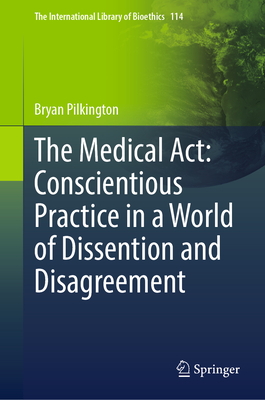
The Medical Act: Conscientious Practice in a World of Dissention and Disagreement
| AUTHOR | Pilkington, Bryan |
| PUBLISHER | Springer (10/12/2025) |
| PRODUCT TYPE | Hardcover (Hardcover) |
This book takes a step back from the usual debates over conscience in medicine and asks whether the conscientious practice of individual healthcare practitioners is coherent and acceptable on its own. This book argues in the affirmative and describes how we move forward in light of the deep moral and professional disagreement that exists. The book explains why the current framing within the debate is mistaken and offers an alternative framing. In so doing, the author discusses disagreement within healthcare professions, the distinction between conscience protectors and conscience dissenters, and how to properly understand the role of religious and personal philosophical reasons in practicing conscientiously. The book articulates the key confusion in much of the current debate - that disagreement over conscience in medicine is due to religious or personal philosophical beliefs - and rejects it. The book then, positively, argues that differing accounts of moral responsibility are at the root of this disagreement, opening up new avenues for dialogue and potentially fruitful collaborations. The book concludes with a much needed and basic discussion of what is going on when practical judgements are made in healthcare: the medical act. This book is of great interest to both advanced undergraduate and graduate students in philosophy, bioethics, and medicine, as well as researchers, physicians, and health professionals.
This book takes a step back, and asks whether the conscientious practice of individual healthcare practitioners is coherent and acceptable on its own. This book argues that the conscientious practice of individual healthcare practitioners is coherent and acceptable on its own, and describes how we move forward in light of the deep moral and professional disagreement that exists. The book explains the mistaken framing and in order to articulate a better one, the author examines the debate and frames discussions in light of conscientious practice and conscience dissension. With this framing, the author discusses disagreement within healthcare professions, which leads to the key confusion in much of the debate, which is subsequently clarified, and ultimately argued is not due to religious beliefs. Though many claim, to the contrary, that religious beliefs give rise to the situations that often call for discussions of conscientious objection, this book argues that differing accounts of moral responsibility are at the root of this disagreement. The author takes up moral responsibility in Chapter 4, which leads to the needed - and importantly basic - discussion of what is going on when practical judgements are made in healthcare: the medical act. This book is of great interest to both (advanced undergraduate and) graduate students in philosophy and bioethics, as well as researchers and health care professionals.
This book takes a step back from the usual debates over conscience in medicine and asks whether the conscientious practice of individual healthcare practitioners is coherent and acceptable on its own. This book argues in the affirmative and describes how we move forward in light of the deep moral and professional disagreement that exists. The book explains why the current framing within the debate is mistaken and offers an alternative framing. In so doing, the author discusses disagreement within healthcare professions, the distinction between conscience protectors and conscience dissenters, and how to properly understand the role of religious and personal philosophical reasons in practicing conscientiously. The book articulates the key confusion in much of the current debate - that disagreement over conscience in medicine is due to religious or personal philosophical beliefs - and rejects it. The book then, positively, argues that differing accounts of moral responsibility are at the root of this disagreement, opening up new avenues for dialogue and potentially fruitful collaborations. The book concludes with a much needed and basic discussion of what is going on when practical judgements are made in healthcare: the medical act. This book is of great interest to both advanced undergraduate and graduate students in philosophy, bioethics, and medicine, as well as researchers, physicians, and health professionals.