
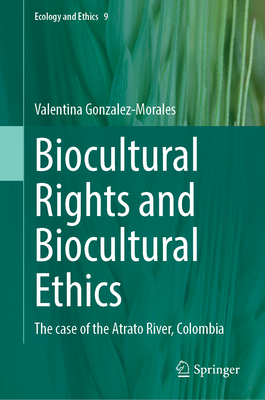
Biocultural Rights and Biocultural Ethics: The Case of the Atrato River, Colombia (Not yet published)
| AUTHOR | Gonzalez-Morales, Valentina |
| PUBLISHER | Springer (01/27/2026) |
| PRODUCT TYPE | Hardcover (Hardcover) |
In 2016, Colombia introduced the concept of biocultural rights into its Constitution; an unprecedented legal development that has since shaped environmental and human rights discourse both nationally and internationally. An important moment in this shift was the recognition of the Atrato River as a subject of rights, establishing a legal mechanism to protect not only the ecosystem itself but also the Afro-Colombian communities whose cultural and spiritual identities are deeply intertwined with the river.
This book explores the challenges of implementing biocultural rights in countries with weak governance structures. Legal recognition alone proves insufficient in contexts where state control is fragmented and power is often exercised by corporations, armed groups, and illicit networks. Addressing biocultural diversity requires engaging with cultural dimensions such as identity, worldviews, philosophical assumptions, and moral frameworks.
Through an in-depth analysis of the Atrato River case, the 3Hs framework of biocultural ethics is applied to interconnect historical, biophysical, cultural, and political dimensions. This approach reveals the potential of biocultural rights to foster more equitable and sustainable forms of coexistence between human and other-than-human communities.
Offering a critical perspective on legal innovation in fragile states, this book provides valuable insights for advancing biocultural conservation and transitioning toward governance models that support the flourishing of biocultural diversity.
In 2016, Colombia introduced the concept of biocultural rights into its Constitution; an unprecedented legal development that has since shaped environmental and human rights discourse both nationally and internationally. An important moment in this shift was the recognition of the Atrato River as a subject of rights, establishing a legal mechanism to protect not only the ecosystem itself but also the Afro-Colombian communities whose cultural and spiritual identities are deeply intertwined with the river.
This book explores the challenges of implementing biocultural rights in countries with weak governance structures. Legal recognition alone proves insufficient in contexts where state control is fragmented and power is often exercised by corporations, armed groups, and illicit networks. Addressing biocultural diversity requires engaging with cultural dimensions such as identity, worldviews, philosophical assumptions, and moral frameworks.
Through an in-depth analysis of the Atrato River case, the 3Hs framework of biocultural ethics is applied to interconnect historical, biophysical, cultural, and political dimensions. This approach reveals the potential of biocultural rights to foster more equitable and sustainable forms of coexistence between human and other-than-human communities.
Offering a critical perspective on legal innovation in fragile states, this book provides valuable insights for advancing biocultural conservation and transitioning toward governance models that support the flourishing of biocultural diversity.
In 2016, Colombia introduced the concept of biocultural rights into its Constitution; an unprecedented legal development that has since shaped environmental and human rights discourse both nationally and internationally. An important moment in this shift was the recognition of the Atrato River as a subject of rights, establishing a legal mechanism to protect not only the ecosystem itself but also the Afro-Colombian communities whose cultural and spiritual identities are deeply intertwined with the river.
This book explores the challenges of implementing biocultural rights in countries with weak governance structures. Legal recognition alone proves insufficient in contexts where state control is fragmented and power is often exercised by corporations, armed groups, and illicit networks. Addressing biocultural diversity requires engaging with cultural dimensions such as identity, worldviews, philosophical assumptions, and moral frameworks.
Through an in-depth analysis of the Atrato River case, the 3Hs framework of biocultural ethics is applied to interconnect historical, biophysical, cultural, and political dimensions. This approach reveals the potential of biocultural rights to foster more equitable and sustainable forms of coexistence between human and other-than-human communities.
Offering a critical perspective on legal innovation in fragile states, this book provides valuable insights for advancing biocultural conservation and transitioning toward governance models that support the flourishing of biocultural diversity.