
Hundert Jahre an der Schnittstelle von Chemie und Physik
| AUTHOR | Hoffmann, Dieter; Steinhauser, Thomas; James, Jeremiah |
| PUBLISHER | de Gruyter (10/17/2011) |
| PRODUCT TYPE | Hardcover (Hardcover) |
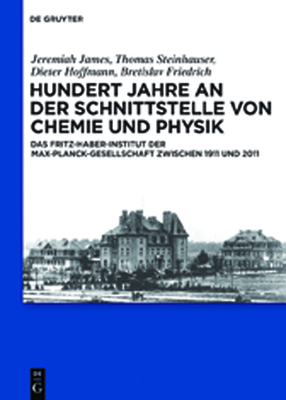
This volume, occasioned by the centenary of the Fritz Haber Institute, formerly the Institute for Physical Chemistry and Electrochemistry, covers the institute's scientific and institutional history from its founding until the present. The institute was among the earliest established by the Kaiser Wilhelm Society, and its inauguration was one of the first steps in the development of Berlin-Dahlem into a center for scientific research. Its establishment was made possible by an endowment from Leopold Koppel, granted on the condition that Fritz Haber, well-known for his discovery of a method to synthesize ammonia from its elements, be made its director. The history of the institute has largely paralleled that of 20th-century Germany. It undertook controversial weapons research during World War I, followed by a "Golden Era" during the 1920s, in spite of financial hardships. Under the National Socialists it experienced a purge of its scientific staff and a diversion of its research into the service of the new regime, accompanied by a breakdown in its international relations. In the immediate aftermath of World War II it suffered crippling material losses, from which it recovered slowly in the post-war era. In 1953, shortly after taking the name of its founding director, the institute joined the fledgling Max Planck Society. During the 1950s and 60s, the institute supported diverse researches into the structure of matter and electron microscopy in a territorially insular and politically precarious West-Berlin. In subsequent decades, as both Berlin and the Max Planck Society underwent significant changes, the institute reorganized around a board of coequal scientific directors and a renewed focus on the investigation of elementary processes on surfaces and interfaces, topics of research that had been central to the work of Fritz Haber and the first "Golden Era" of the institute.
Dieses Werk anlsslich des hundertjhrigen Bestehens des Fritz-Haber-Instituts, vormals Kaiser-Wilhelm-Institut fr physikalische Chemie und Elektrochemie, umfasst die wissenschaftliche und institutionelle Geschichte des Instituts von dessen Grndung 1911 als eines der ersten beiden Institute der Kaiser-Wilhelm-Gesellschaft, ber die Benennung nach seinem Grndungsdirektor 1952 und die Eingliederung in die Max-Planck-Gesellschaft, bis zur Gegenwart. Die richtungsweisende Forschungsarbeit des Instituts fr die Physikalische Chemie und Chemische Physik wurde von zahlreichen hervorragenden Wissenschaftlern, unter ihnen sieben Nobelpreistrger, geprgt.
This volume, occasioned by the centenary of the Fritz Haber Institute, formerly the Institute for Physical Chemistry and Electrochemistry, covers the institute's scientific and institutional history from its founding until the present. The institute was among the earliest established by the Kaiser Wilhelm Society, and its inauguration was one of the first steps in the development of Berlin-Dahlem into a center for scientific research. Its establishment was made possible by an endowment from Leopold Koppel, granted on the condition that Fritz Haber, well-known for his discovery of a method to synthesize ammonia from its elements, be made its director. The history of the institute has largely paralleled that of 20th-century Germany. It undertook controversial weapons research during World War I, followed by a "Golden Era" during the 1920s, in spite of financial hardships. Under the National Socialists it experienced a purge of its scientific staff and a diversion of its research into the service of the new regime, accompanied by a breakdown in its international relations. In the immediate aftermath of World War II it suffered crippling material losses, from which it recovered slowly in the post-war era. In 1953, shortly after taking the name of its founding director, the institute joined the fledgling Max Planck Society. During the 1950s and 60s, the institute supported diverse researches into the structure of matter and electron microscopy in a territorially insular and politically precarious West-Berlin. In subsequent decades, as both Berlin and the Max Planck Society underwent significant changes, the institute reorganized around a board of coequal scientific directors and a renewed focus on the investigation of elementary processes on surfaces and interfaces, topics of research that had been central to the work of Fritz Haber and the first "Golden Era" of the institute.