
Back to Search

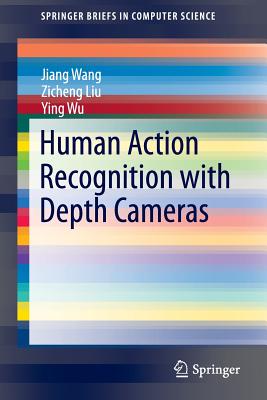
Human Action Recognition with Depth Cameras

AUTHOR Wang, Jiang; Liu, Zicheng; Wu, Ying
PUBLISHER Springer (02/04/2014)
PRODUCT TYPE Paperback (Paperback)

Description
Action recognition technology has many real-world applications in human-computer interaction, surveillance, video retrieval, retirement home monitoring, and robotics. The commoditization of depth sensors has also opened up further applications that were not feasible before. This text focuses on feature representation and machine learning algorithms for action recognition from depth sensors. After presenting a comprehensive overview of the state of the art, the authors then provide in-depth descriptions of their recently developed feature representations and machine learning techniques, including lower-level depth and skeleton features, higher-level representations to model the temporal structure and human-object interactions, and feature selection techniques for occlusion handling. This work enables the reader to quickly familiarize themselves with the latest research, and to gain a deeper understanding of recently developed techniques. It will be of great use for both researchers andpractitioners.
Show More
Product Format
Product Details
ISBN-13: 9783319045603
ISBN-10: 3319045601
Binding: Paperback or Softback (Trade Paperback (Us))
Content Language: English
More Product Details
Page Count: 59
Carton Quantity: 120
Product Dimensions: 6.14 x 0.14 x 9.21 inches
Weight: 0.24 pound(s)
Feature Codes: Maps, Illustrated
Country of Origin: NL
Subject Information
BISAC Categories
Computers | Software Development & Engineering - Computer Graphics
Computers | Artificial Intelligence - Computer Vision & Pattern Recognit
Computers | User Interfaces
Dewey Decimal: 005.437
Descriptions, Reviews, Etc.
jacket back

Action recognition is an enabling technology for many real world applications, such as human-computer interaction, surveillance, video retrieval, retirement home monitoring, and robotics. In the past decade, it has attracted a great amount of interest in the research community. Recently, the commoditization of depth sensors has generated much excitement in action recognition from depth sensors. New depth sensor technology has enabled many applications that were not feasible before. On one hand, action recognition becomes far easier with depth sensors. On the other hand, the drive to recognize more complex actions presents new challenges.

One crucial aspect of action recognition is to extract discriminative features. The depth maps have completely different characteristics from the RGB images. Directly applying features designed for RGB images does not work.

Complex actions usually involve complicated temporal structures, human-object interactions, and person-person contacts. New machine learning algorithms need to be developed to learn these complex structures.

This work enables the reader to quickly familiarize themselves with the latest research in depth-sensor based action recognition, and to gain a deeper understanding of recently developed techniques. It will be of great use for both researchers and practitioners who are interested in human action recognition with depth sensors.

The text focuses on feature representation and machine learning algorithms for action recognition from depth sensors. After presenting a comprehensive overview of the state of the art in action recognition from depth data, the authors then provide in-depth descriptions of their recently developed feature representations and machine learning techniques, including lower-level depth and skeleton features, higher-level representations to model the temporal structure and human-object interactions, and feature selection techniques for occlusion handling.
Show More
publisher marketing
Action recognition technology has many real-world applications in human-computer interaction, surveillance, video retrieval, retirement home monitoring, and robotics. The commoditization of depth sensors has also opened up further applications that were not feasible before. This text focuses on feature representation and machine learning algorithms for action recognition from depth sensors. After presenting a comprehensive overview of the state of the art, the authors then provide in-depth descriptions of their recently developed feature representations and machine learning techniques, including lower-level depth and skeleton features, higher-level representations to model the temporal structure and human-object interactions, and feature selection techniques for occlusion handling. This work enables the reader to quickly familiarize themselves with the latest research, and to gain a deeper understanding of recently developed techniques. It will be of great use for both researchers andpractitioners.
Show More
List Price $54.99
Your Price  $54.44
Paperback