
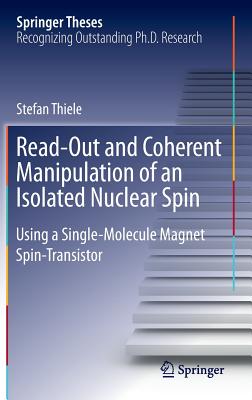
Read-Out and Coherent Manipulation of an Isolated Nuclear Spin: Using a Single-Molecule Magnet Spin-Transistor
| AUTHOR | Thiele, Stefan |
| PUBLISHER | Springer (12/04/2015) |
| PRODUCT TYPE | Hardcover (Hardcover) |
Description
This thesis sheds new light on the worldwide first electrical manipulation of a single nuclear spin. Over the last four decades, the size of a bit, the smallest logical unit in a computer, has decreased by more than two orders of magnitude and will soon reach a limit where quantum phenomena become important. Inspired by the power of quantum mechanics, researchers have already identified pure quantum systems, having, analog to a classical bit, two controllable and readable states. In this regard, the inherent spin of electrons or nuclei with its two eigenstates, spin up and spin down, is a promising candidate. Using expertise in the field of single-molecule magnets, the author developed a molecular transistor, which allows quantum information to be written onto a single nuclear spin by means of an electric field only, and, in addition, enables the electronic read-out of this quantum state. This novel approach opens a path to addressing and manipulating individual nuclear spins within a very confined space (a single molecule), at high speed. Thus, the author was able to show that single molecule magnets are promising candidates for quantum information processing, which is triggering a new field of research towards molecular quantum electronics.
Show More
Product Format
Product Details
ISBN-13:
9783319240565
ISBN-10:
3319240560
Binding:
Hardback or Cased Book (Sewn)
Content Language:
English
More Product Details
Page Count:
159
Carton Quantity:
38
Product Dimensions:
6.14 x 0.44 x 9.21 inches
Weight:
0.94 pound(s)
Feature Codes:
Illustrated
Country of Origin:
NL
Subject Information
BISAC Categories
Computers | Information Technology
Computers | Physics - Atomic & Molecular
Computers | Physics - Nuclear
Dewey Decimal:
538
Descriptions, Reviews, Etc.
jacket back
This thesis sheds new light on the worldwide first electrical manipulation of a single nuclear spin. Over the last four decades, the size of a bit, the smallest logical unit in a computer, has decreased by more than two orders of magnitude and will soon reach a limit where quantum phenomena become important. Inspired by the power of quantum mechanics, researchers have already identified pure quantum systems, having, analog to a classical bit, two controllable and readable states. In this regard, the inherent spin of electrons or nuclei with its two eigenstates, spin up and spin down, is a promising candidate. Using expertise in the field of single-molecule magnets, the author developed a molecular transistor, which allows quantum information to be written onto a single nuclear spin by means of an electric field only, and, in addition, enables the electronic read-out of this quantum state. This novel approach opens a path to addressing and manipulating individual nuclear spins within avery confined space (a single molecule), at high speed. Thus, the author was able to show that single molecule magnets are promising candidates for quantum information processing, which is triggering a new field of research towards molecular quantum electronics.
Show More
publisher marketing
This thesis sheds new light on the worldwide first electrical manipulation of a single nuclear spin. Over the last four decades, the size of a bit, the smallest logical unit in a computer, has decreased by more than two orders of magnitude and will soon reach a limit where quantum phenomena become important. Inspired by the power of quantum mechanics, researchers have already identified pure quantum systems, having, analog to a classical bit, two controllable and readable states. In this regard, the inherent spin of electrons or nuclei with its two eigenstates, spin up and spin down, is a promising candidate. Using expertise in the field of single-molecule magnets, the author developed a molecular transistor, which allows quantum information to be written onto a single nuclear spin by means of an electric field only, and, in addition, enables the electronic read-out of this quantum state. This novel approach opens a path to addressing and manipulating individual nuclear spins within a very confined space (a single molecule), at high speed. Thus, the author was able to show that single molecule magnets are promising candidates for quantum information processing, which is triggering a new field of research towards molecular quantum electronics.
Show More
List Price $109.99
Your Price
$108.89