
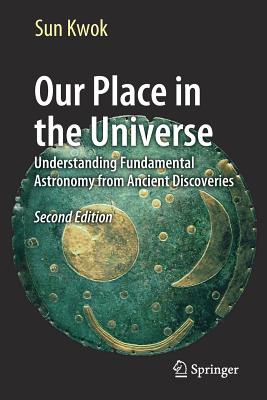
Our Place in the Universe: Understanding Fundamental Astronomy from Ancient Discoveries
| AUTHOR | Kwok, Sun |
| PUBLISHER | Springer (05/02/2017) |
| PRODUCT TYPE | Paperback (Paperback) |
If you have ever wanted to understand the basic principles of astronomy and celestial movements, you should read this book. Using pictures of the sky observed from different places on Earth, as well as drawings of ancient astronomical methods and tools, Prof. Sun Kwok tells this story in an entertaining and fascinating way.
Since the beginning of human civilization, people have wondered about the structure of the cosmos and our place in the Universe. More than 2,000 years ago, our ancestors knew that the seasons were unequal, the Earth was an unattached object floating in space, and stars existed that they could not see. From celestial observations, they concluded that the Earth was round. Using simple tools and mathematics, ancient astronomers accurately determined the sizes of the Earth and Moon, the distance to the Moon, and the lengths of the months and year.
With a clever device called the armillary sphere, Greek astronomers could predict the times of sunrise and sunset on any day of the year, at any place on Earth. They developed sophisticated mathematical models to forecast Mars' motions hundreds of years into the future.
If you have ever wanted to understand the basic principles of astronomy and celestial movements, you should read this book. Using pictures of the sky observed from different places on Earth, as well as drawings of ancient astronomical methods and tools, Prof. Sun Kwok tells this story in an entertaining and fascinating way.
Since the beginning of human civilization, people have wondered about the structure of the cosmos and our place in the Universe. More than 2,000 years ago, our ancestors knew that the seasons were unequal, the Earth was an unattached object floating in space, and stars existed that they could not see. From celestial observations, they concluded that the Earth was round. Using simple tools and mathematics, ancient astronomers accurately determined the sizes of the Earth and Moon, the distance to the Moon, and the lengths of the months and year.
With a clever device called the armillary sphere, Greek astronomers could predict the times of sunrise and sunset on any day of the year, at any place on Earth. They developed sophisticated mathematical models to forecast Mars' motions hundreds of years into the future.
If you have ever wanted to understand the basic principles of astronomy and celestial movements, you should read this book. Using pictures of the sky observed from different places on Earth, as well as drawings of ancient astronomical methods and tools, Prof. Sun Kwok tells this story in an entertaining and fascinating way.
Since the beginning of human civilization, people have wondered about the structure of the cosmos and our place in the Universe. More than 2,000 years ago, our ancestors knew that the seasons were unequal, the Earth was an unattached object floating in space, and stars existed that they could not see. From celestial observations, they concluded that the Earth was round. Using simple tools and mathematics, ancient astronomers accurately determined the sizes of the Earth and Moon, the distance to the Moon, and the lengths of the months and year.
With a clever device called the armillary sphere, Greek astronomers could predict the times of sunrise and sunset on any day of the year, at any place on Earth. They developed sophisticated mathematical models to forecast Mars' motions hundreds of years into the future.