
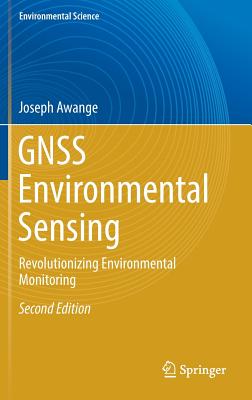
Gnss Environmental Sensing: Revolutionizing Environmental Monitoring
| AUTHOR | Awange, Joseph |
| PUBLISHER | Springer (09/12/2017) |
| PRODUCT TYPE | Hardcover (Hardcover) |
Description
Showcases global navigation satellite system (GNSS) sensing of climate variability with examplesDiscusses the first probe at the upper troposphere and lower stratosphere
Presents the applications of unmanned aircraft vehicles (UAV)/drones with examples
Simplifies the theory of GNSS for environmentalists interested in its applications
Presents the applications simply to motivate those involved in GNSS theory to push the boundaries
Presents the applications of unmanned aircraft vehicles (UAV)/drones with examples
Simplifies the theory of GNSS for environmentalists interested in its applications
Presents the applications simply to motivate those involved in GNSS theory to push the boundaries
Show More
Product Format
Product Details
ISBN-13:
9783319584171
ISBN-10:
3319584170
Binding:
Hardback or Cased Book (Sewn)
Content Language:
English
Edition Number:
0002
More Product Details
Page Count:
452
Carton Quantity:
16
Product Dimensions:
6.14 x 1.06 x 9.21 inches
Weight:
1.85 pound(s)
Feature Codes:
Maps,
Illustrated
Country of Origin:
NL
Subject Information
BISAC Categories
Technology & Engineering | Environmental - Pollution Control
Technology & Engineering | Environmental Conservation & Protection - General
Technology & Engineering | Natural Resources
Dewey Decimal:
333.7
Descriptions, Reviews, Etc.
jacket back
This book is the second edition of Environmental Monitoring using GNSS and highlights the latest developments in global navigation satellite systems (GNSS). It features a completely new title and additional chapters that present emerging challenges to environmental monitoring--"climate variability/change and food insecurity."
Since the publication of the first edition, much has changed in both the development and applications of GNSS, a satellite microwave remote sensing technique. It is the first tool to span all four dimensions of relevance to humans (position, navigation, timing and the environment), and it has widely been used for positioning (both by military and civilians), navigation and timing. Its increasing use is leading to a new era of remote sensing that is now revolutionizing the art of monitoring our environment in ways never imagined before.
On the one hand, nearly all GNSS satellites (Global Positioning System (GPS), Global Navigation Satellite System (GLONASS), Galileo and Beidou) have become operational, thereby providing high-precision, continuous, all-weather and near real- time remote sensing multi-signals beneficial to environmental monitoring. On the other hand, the emerging challenges of precisely monitoring climate change and the demand for the production of sufficient food for ever-increasing populations are pushing traditional monitoring methods to their limits.
In this regard, refracted GNSS signals (i.e., occulted GNSS signals or GNSS meteorology) are now emerging as sensors of climate variability, while the reflected signals (GNSS reflectometry or GNSS-R) are increasingly finding applications in determining, e.g., soil moisture content, ice and snow thickness, ocean heights, and wind speed and direction, among others. Furthermore, the increasing recognition and application of GNSS-supported unmanned aircraft vehicles (UAV)/drones in agriculture (e.g., through the determination of water holding capacity of soil) highlights the new challenges facing GNSS.
As such, this new edition three new chapters address GNSS reflectometry and applications; GNSS sensing of climate variability; and the applications in UAV/drones. Moreover, it explores the application of GNSS to support integrated coastal zone management.
Since the publication of the first edition, much has changed in both the development and applications of GNSS, a satellite microwave remote sensing technique. It is the first tool to span all four dimensions of relevance to humans (position, navigation, timing and the environment), and it has widely been used for positioning (both by military and civilians), navigation and timing. Its increasing use is leading to a new era of remote sensing that is now revolutionizing the art of monitoring our environment in ways never imagined before.
On the one hand, nearly all GNSS satellites (Global Positioning System (GPS), Global Navigation Satellite System (GLONASS), Galileo and Beidou) have become operational, thereby providing high-precision, continuous, all-weather and near real- time remote sensing multi-signals beneficial to environmental monitoring. On the other hand, the emerging challenges of precisely monitoring climate change and the demand for the production of sufficient food for ever-increasing populations are pushing traditional monitoring methods to their limits.
In this regard, refracted GNSS signals (i.e., occulted GNSS signals or GNSS meteorology) are now emerging as sensors of climate variability, while the reflected signals (GNSS reflectometry or GNSS-R) are increasingly finding applications in determining, e.g., soil moisture content, ice and snow thickness, ocean heights, and wind speed and direction, among others. Furthermore, the increasing recognition and application of GNSS-supported unmanned aircraft vehicles (UAV)/drones in agriculture (e.g., through the determination of water holding capacity of soil) highlights the new challenges facing GNSS.
As such, this new edition three new chapters address GNSS reflectometry and applications; GNSS sensing of climate variability; and the applications in UAV/drones. Moreover, it explores the application of GNSS to support integrated coastal zone management.
Show More
publisher marketing
Showcases global navigation satellite system (GNSS) sensing of climate variability with examplesDiscusses the first probe at the upper troposphere and lower stratosphere
Presents the applications of unmanned aircraft vehicles (UAV)/drones with examples
Simplifies the theory of GNSS for environmentalists interested in its applications
Presents the applications simply to motivate those involved in GNSS theory to push the boundaries
Presents the applications of unmanned aircraft vehicles (UAV)/drones with examples
Simplifies the theory of GNSS for environmentalists interested in its applications
Presents the applications simply to motivate those involved in GNSS theory to push the boundaries
Show More
List Price $199.99
Your Price
$197.99