
Back to Search

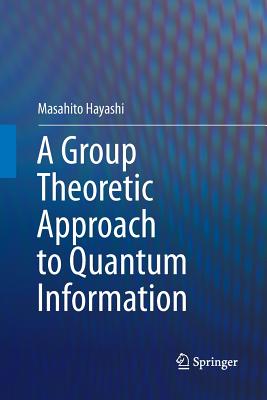
A Group Theoretic Approach to Quantum Information

AUTHOR Hayashi, Masahito
PUBLISHER Springer (06/28/2018)
PRODUCT TYPE Paperback (Paperback)

Description
This book is the first one addressing quantum information from the viewpoint of group symmetry. Quantum systems have a group symmetrical structure. This structure enables to handle systematically quantum information processing. However, there is no other textbook focusing on group symmetry for quantum information although there exist many textbooks for group representation. After the mathematical preparation of quantum information, this book discusses quantum entanglement and its quantification by using group symmetry. Group symmetry drastically simplifies the calculation of several entanglement measures although their calculations are usually very difficult to handle. This book treats optimal information processes including quantum state estimation, quantum state cloning, estimation of group action and quantum channel etc. Usually it is very difficult to derive the optimal quantum information processes without asymptotic setting of these topics. However, group symmetry allows to derive these optimal solutions without assuming the asymptotic setting. Next, this book addresses the quantum error correcting code with the symmetric structure of Weyl-Heisenberg groups. This structure leads to understand the quantum error correcting code systematically. Finally, this book focuses on the quantum universal information protocols by using the group SU(d). This topic can be regarded as a quantum version of the Csiszar-Korner's universal coding theory with the type method. The required mathematical knowledge about group representation is summarized in the companion book, Group Representation for Quantum Theory.
Show More
Product Format
Product Details
ISBN-13: 9783319832487
ISBN-10: 3319832484
Binding: Paperback or Softback (Trade Paperback (Us))
Content Language: English
More Product Details
Page Count: 228
Carton Quantity: 32
Product Dimensions: 6.14 x 0.51 x 9.21 inches
Weight: 0.76 pound(s)
Feature Codes: Illustrated
Country of Origin: NL
Subject Information
BISAC Categories
Computers | Information Technology
Computers | Physics - Quantum Theory
Computers | Algebra - Abstract
Dewey Decimal: 004.1
Descriptions, Reviews, Etc.
publisher marketing
This book is the first one addressing quantum information from the viewpoint of group symmetry. Quantum systems have a group symmetrical structure. This structure enables to handle systematically quantum information processing. However, there is no other textbook focusing on group symmetry for quantum information although there exist many textbooks for group representation. After the mathematical preparation of quantum information, this book discusses quantum entanglement and its quantification by using group symmetry. Group symmetry drastically simplifies the calculation of several entanglement measures although their calculations are usually very difficult to handle. This book treats optimal information processes including quantum state estimation, quantum state cloning, estimation of group action and quantum channel etc. Usually it is very difficult to derive the optimal quantum information processes without asymptotic setting of these topics. However, group symmetry allows to derive these optimal solutions without assuming the asymptotic setting. Next, this book addresses the quantum error correcting code with the symmetric structure of Weyl-Heisenberg groups. This structure leads to understand the quantum error correcting code systematically. Finally, this book focuses on the quantum universal information protocols by using the group SU(d). This topic can be regarded as a quantum version of the Csiszar-Korner's universal coding theory with the type method. The required mathematical knowledge about group representation is summarized in the companion book, Group Representation for Quantum Theory.
Show More

Author: Hayashi, Masahito
Hiroshi Imai was born in 1958 at Kobe, Japan. He obtained B.Eng. in Mathematical Engineering, and M.Eng. and D.Eng. in Information Engineering, University of Tokyo in 1981, 1983 and 1986, respectively. In 1986-1990, he was an associate professor of Department of Computer Science and Communication Engineering, Kyushu University. He was also a visiting associate professor at School of Computer Science, McGill University in 1987 and a visiting scientist at IBM T. J. Watson Research Center in 1988. Since 1990, he joined Department of Information Science, University of Tokyo. He is now a professor in Department of Computer Science, Univeristy of Tokyo. He has been a project leader of ERATO Quantum Computation and Information Project, JST from 2000. His research interests include quantum information science, algorithmics, computational geometry, and optimization.

Masahito Hayashi was born in Japan in 1971.He received the B. S. degree from Faculty of Sciences in Kyoto University, Japan, in 1994 and the M. S. and Ph. D. degrees in Mathematics from Kyoto University, Japan, in 1996 and 1999, respectively. He worked in Kyoto University as a Research Fellow of the Japan Society of the Promotion of Science from 1998 to 2000, and worked in the Laboratory for Mathematical Neuroscience, Brain Science Institute, RIKEN from 2000 to 2003.In 2003, he joined Quantum Computation and Information Project, ERATO, JST as the Research Head. He also works in Superrobust Computation Project Information Science and Technology Strategic Core (21st Century COE by MEXT) Graduate School of Information Science and Technology. The University of Tokyo as Adjunct Associate Professor from 2004. He is an EditorialBoard of International Journal of Quantum Information, and is the author of Quantum Information Theory, which will be published from Springer in this March. He also edited "Asymptotic Theory of Quantum Statistical Inference: Selected Papers" (World Scientific 2005) and Special Issue of EQIS'03 conference in International Journal of Quantum Information. His research interests include quantum information theory and quantum statistical inference.

Show More
List Price $54.99
Your Price  $54.44
Paperback