
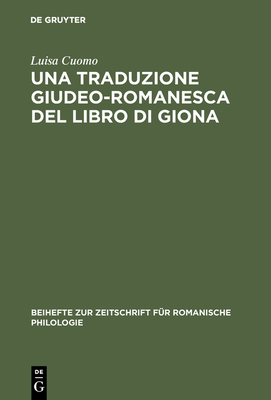
Una Traduzione Giudeo-Romanesca del Libro Di Giona
| AUTHOR | Cuomo, Luisa |
| PUBLISHER | de Gruyter (08/23/1988) |
| PRODUCT TYPE | Hardcover (Hardcover) |
The work contributes to the current debate on the linguistic definition of Judeo-Italian. It consists of an edition of the unedited translation of Jonah (Palatine Library, Parma, Ms. 3086) together with a comprehensive linguistic analysis of the text - graphic system, phonology, morphology, syntax, lexicon and phraseology. The study shows conclusively that the language of the translation leads both to the Roman dialect of the first half of the 16th century as to the contemporary dialects of Latium, and that its translator was an educated person who aspired to an elevated literary register. This he achieves without submitting to the pervasive influence generally exerted by Tuscan dialects, and in the act seems to reaffirm the validity of the traditional Jewish technique for translating sacred texts the interlinear or 'calque' method.
The work contributes to the current debate on the linguistic definition of Judeo-Italian. It consists of an edition of the unedited translation of Jonah (Palatine Library, Parma, Ms. 3086) together with a comprehensive linguistic analysis of the text - graphic system, phonology, morphology, syntax, lexicon and phraseology. The study shows conclusively that the language of the translation leads both to the Roman dialect of the first half of the 16th century as to the contemporary dialects of Latium, and that its translator was an educated person who aspired to an elevated literary register. This he achieves without submitting to the pervasive influence generally exerted by Tuscan dialects, and in the act seems to reaffirm the validity of the traditional Jewish technique for translating sacred texts the interlinear or 'calque' method.