
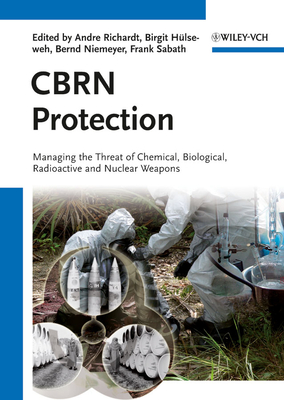
Cbrn Protection: Managing the Threat of Chemical, Biological, Radioactive and Nuclear Weapons
| AUTHOR | Richardt, Andre; Richardt, Andre; Richardt, Andre et al. |
| PUBLISHER | Wiley-Vch (12/26/2012) |
| PRODUCT TYPE | Hardcover (Hardcover) |
Originating in the armed forces of the early 20th century, weapons based on chemical, biological or nuclear agents have become an everpresent threat that has not vanished after the end of the cold war. Since the technology to produce these agents is nowadays available to many countries and organizations, including those with terrorist aims, civil authorities across the world need to prepare against incidents involving these agents and train their personnel accordingly.
As an introductory text on NBC CBRN weapons and agents, this book leads the reader from the scientific basics to the current threats and strategies to prepare against them. After an introductory part on the history of NBC CBRN weapons and their international control, the three classes of nuclear/radiological, biological, and chemical weapons are introduced, focusing on agents and delivery vehicles. Current methods for the rapid detection of NBC CBRN agents are introduced, and the principles of physical protection of humans and structures are explained.
The final parts addresses more general issues of risk management, preparedness and response management, as the set of tools that authorities and civil services will be needed in a future CBRN scenario as well as the likely future scenarios that authorities and civil services will be faced with in the coming years.
This book is a must-have for Health Officers, Public Health Agencies, and Military Authorities.
Originating in the armed forces of the early 20th century, weapons based on chemical, biological or nuclear agents have become an everpresent threat that has not vanished after the end of the cold war. Since the technology to produce these agents is nowadays available to many countries and organizations, including those with terrorist aims, civil authorities across the world need to prepare against incidents involving these agents and train their personnel accordingly.
As an introductory text on NBC CBRN weapons and agents, this book leads the reader from the scientific basics to the current threats and strategies to prepare against them. After an introductory part on the history of NBC CBRN weapons and their international control, the three classes of nuclear/radiological, biological, and chemical weapons are introduced, focusing on agents and delivery vehicles. Current methods for the rapid detection of NBC CBRN agents are introduced, and the principles of physical protection of humans and structures are explained.
The final parts addresses more general issues of risk management, preparedness and response management, as the set of tools that authorities and civil services will be needed in a future CBRN scenario as well as the likely future scenarios that authorities and civil services will be faced with in the coming years.
This book is a must-have for Health Officers, Public Health Agencies, and Military Authorities.
Marc-Michael Blum currently works in Munich as an independent contractor of the German army medical corps. He studied chemistry at the Technical University Braunschweig, the Humboldt University Berlin and the University of Birmingham, UK. As a Ph.D. candidate he worked in the group of Prof. H. Rutterjans at the J. W. Goethe University in Frankfurt on the enzyme DFPase from squid. He serves as a reserve officer at the German army NBC defense school, is a member of the Insitute of Strategic Studies in London. His research interest include enzyme mechanisms and structural biology with a recent focus on neutron diffraction. In the field of biological and chemical warfare he is interested in new decontamination and detection technologies as well as arms control and disarmament.
Marc-Michael Blum currently works in Munich as an independent contractor of the German army medical corps. He studied chemistry at the Technical University Braunschweig, the Humboldt University Berlin and the University of Birmingham, UK. As a Ph.D. candidate he worked in the group of Prof. H. Rutterjans at the J. W. Goethe University in Frankfurt on the enzyme DFPase from squid. He serves as a reserve officer at the German army NBC defense school, is a member of the Insitute of Strategic Studies in London. His research interest include enzyme mechanisms and structural biology with a recent focus on neutron diffraction. In the field of biological and chemical warfare he is interested in new decontamination and detection technologies as well as arms control and disarmament.