
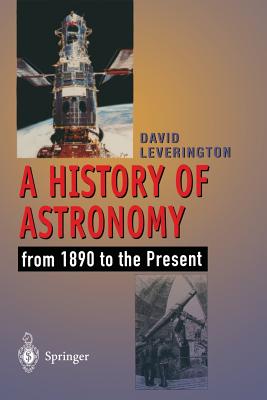
A History of Astronomy: From 1890 to the Present
| AUTHOR | Leverington, David |
| PUBLISHER | Springer (11/06/1995) |
| PRODUCT TYPE | Paperback (Paperback) |
Description
The history of astronomy is, like most history, a multidimensional story, and when writing about a specific period, the author has to decide how to handle all the developments of earlier times in order to set the scene. I have done this by starting most chapters of the book with a summary of astronomical knowledge at the beginning of our chosen period, together with a brief review of how such knowledge had been gained. This story is not only interesting in itself, but it will also assist those readers that would appreciate a brief reminder of some of the basic elements of astronomy. It is also necessary to decide when to start our history. Should it be the year 1900 or 1890, or should it be linked to some key development or investigation, e. g. the discovery of the electron by J. J. Thomson in 1897, or the discovery of spectroscopic binary stars by Pickering and Vogel (independently) in 1889, or maybe the year 1890 in which Thomas Edison tried unsuccessfully to detect radio waves from the Sun and Johannes Rydberg published his formula for atomic spectra? I have, in fact, decided to start this history at about 1890, as it was the year of publication of the Draper Memorial Catalogue of stellar spectra which, together with its updates, provided essential data for the understanding of stellar spectra until well into the twentieth century. This date also gives a clear hundred years up to the present.
Show More
Product Format
Product Details
ISBN-13:
9783540199151
ISBN-10:
3540199152
Binding:
Paperback or Softback (Trade Paperback (Us))
Content Language:
English
More Product Details
Page Count:
388
Carton Quantity:
20
Product Dimensions:
6.05 x 0.85 x 9.20 inches
Weight:
1.63 pound(s)
Country of Origin:
US
Subject Information
BISAC Categories
Science | Space Science - Astronomy
Science | Physics - Astrophysics
Dewey Decimal:
520.904
Library of Congress Control Number:
95012034
Descriptions, Reviews, Etc.
publisher marketing
The history of astronomy is, like most history, a multidimensional story, and when writing about a specific period, the author has to decide how to handle all the developments of earlier times in order to set the scene. I have done this by starting most chapters of the book with a summary of astronomical knowledge at the beginning of our chosen period, together with a brief review of how such knowledge had been gained. This story is not only interesting in itself, but it will also assist those readers that would appreciate a brief reminder of some of the basic elements of astronomy. It is also necessary to decide when to start our history. Should it be the year 1900 or 1890, or should it be linked to some key development or investigation, e. g. the discovery of the electron by J. J. Thomson in 1897, or the discovery of spectroscopic binary stars by Pickering and Vogel (independently) in 1889, or maybe the year 1890 in which Thomas Edison tried unsuccessfully to detect radio waves from the Sun and Johannes Rydberg published his formula for atomic spectra? I have, in fact, decided to start this history at about 1890, as it was the year of publication of the Draper Memorial Catalogue of stellar spectra which, together with its updates, provided essential data for the understanding of stellar spectra until well into the twentieth century. This date also gives a clear hundred years up to the present.
Show More
Author:
Leverington, David
David Leverington has held a number of senior positions in the space industry, working for both the European Space Agency and British Aerospace. He is a fellow of the Royal Astronomical Society and author of A History of Astronomy from 1890 to the Present (1996), New Cosmic Horizons: Space Astronomy from the V2 to the Hubble Space Telescope (2000) and Babylon to Voyager: A History of Planetary Astronomy (2003).
Show More
List Price $54.99
Your Price
$54.44