
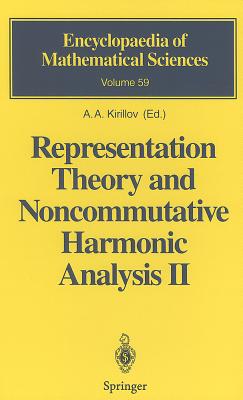
Representation Theory and Noncommutative Harmonic Analysis II: Homogeneous Spaces, Representations and Special Functions
| PUBLISHER | Springer (06/20/1995) |
| PRODUCT TYPE | Hardcover (Hardcover) |
Description
At first only elementary functions were studied in mathematical analysis. Then new functions were introduced to evaluate integrals. They were named special functions: integral sine, logarithms, the exponential function, the prob- ability integral and so on. Elliptic integrals proved to be the most important. They are connected with rectification of arcs of certain curves. The remarkable idea of Abel to replace these integrals by the corresponding inverse functions led to the creation of the theory of elliptic functions. They are doubly periodic functions of a complex variable. This periodicity has led to consideration of the lattice of periods and to linear-fractional trans- formations of the complex plane which leave this lattice invariant. The group of these transformations is isomorphic to the quotient group of the group 8L(2, Z) of unimodular matrices of the second order with integral elements with respect to its center. Investigation of properties of elliptic functions led to the study of automorphic functions and forms. This gave the first connec- tion between the theory of groups and this important class of functions. The further development of the theory of automorphic functions was related to geometric concepts connected with the fact that the group of linear-fractional transformations with real elements can be realized as the group of motions of th the Lobachevskij plane. We also note that at the beginning of the 19 century Gauss used the group 8L(2, Z) in his papers on the theory of indeterminate quadratic forms.
Show More
Product Format
Product Details
ISBN-13:
9783540547020
ISBN-10:
3540547029
Binding:
Hardback or Cased Book (Unsewn / Adhesive Bound)
Content Language:
English
More Product Details
Page Count:
270
Carton Quantity:
28
Product Dimensions:
6.10 x 0.80 x 9.20 inches
Weight:
1.10 pound(s)
Feature Codes:
Bibliography,
Index,
Table of Contents,
Illustrated
Country of Origin:
DE
Subject Information
BISAC Categories
Mathematics | Group Theory
Mathematics | Geometry - Differential
Mathematics | Mathematical Analysis
Dewey Decimal:
510
Descriptions, Reviews, Etc.
jacket back
This EMS volume contains two contributions: the first one, "Harmonic Analysis on Homogeneous Spaces", is written by V.F.Molchanov, the second one, "Representations of Lie Groups and Special Functions", by N.Ya.Vilenkin and A.U.Klimyk. Molchanov focuses on harmonic analysis on semi-simple spaces, whereas Vilenkin and Klimyk treat group theoretical methods also with respect to integral transforms. Both contributions are surveys introducing readers to the above topics and preparing them for the study of more specialised literature. This book will be very useful to mathematicians, theoretical physicists and also to chemists dealing with quantum systems.
Show More
publisher marketing
At first only elementary functions were studied in mathematical analysis. Then new functions were introduced to evaluate integrals. They were named special functions: integral sine, logarithms, the exponential function, the prob- ability integral and so on. Elliptic integrals proved to be the most important. They are connected with rectification of arcs of certain curves. The remarkable idea of Abel to replace these integrals by the corresponding inverse functions led to the creation of the theory of elliptic functions. They are doubly periodic functions of a complex variable. This periodicity has led to consideration of the lattice of periods and to linear-fractional trans- formations of the complex plane which leave this lattice invariant. The group of these transformations is isomorphic to the quotient group of the group 8L(2, Z) of unimodular matrices of the second order with integral elements with respect to its center. Investigation of properties of elliptic functions led to the study of automorphic functions and forms. This gave the first connec- tion between the theory of groups and this important class of functions. The further development of the theory of automorphic functions was related to geometric concepts connected with the fact that the group of linear-fractional transformations with real elements can be realized as the group of motions of th the Lobachevskij plane. We also note that at the beginning of the 19 century Gauss used the group 8L(2, Z) in his papers on the theory of indeterminate quadratic forms.
Show More
List Price $109.99
Your Price
$108.89