
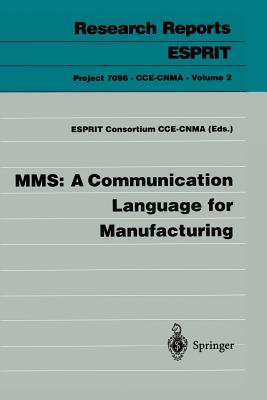
Mms: A Communication Language for Manufacturing
| PUBLISHER | Springer (07/14/1995) |
| PRODUCT TYPE | Paperback (Paperback) |
Description
Today's manufacturing environment is characterised by significant change in the way it is able to respond to its business objectives. Companies now face new challenges to meet customer demands including greater flexibility, a wider range of products, higher quality, improved lead time, whilst maintaining _c.ompetitive prices. The changes manifest in each company will differ but, the trend is towards providing a leaner, more responsive organisation. This is reflected in the need for Information Technology (IT) systems to be more integrated across an enterprise and for the systems to be provided on a distributed basis. At the same time it is imperative that the costs associated with these IT systems and the range of skills required by an enterprise to develop and support such systems should be minimal. One way of achieving this objective is to adopt the use of standards. During recent years there has been a lot of activity to standardise the way that manufacturing devices communicate with each other. Considerable progress has been made, thanks not least to the success of the international effort of stand- ardisation bodies like ISO, IEEE and IEC, and projects applying standardised protocols like Manufacturing Automation Protocol (MAP), in the USA, Commun- ications Network for Manufacturing Applications (CNMA) in Europe and not forgetting Mini-MAP and Fieldbus technology.
Show More
Product Format
Product Details
ISBN-13:
9783540590613
ISBN-10:
3540590617
Binding:
Paperback or Softback (Trade Paperback (Us))
Content Language:
English
More Product Details
Page Count:
185
Carton Quantity:
44
Product Dimensions:
6.14 x 0.42 x 9.21 inches
Weight:
0.63 pound(s)
Feature Codes:
Glossary
Country of Origin:
DE
Subject Information
BISAC Categories
Computers | Design, Graphics & Media - CAD-CAM
Computers | Languages - General
Computers | Database Administration & Management
Dewey Decimal:
670.285
Library of Congress Control Number:
95032964
Descriptions, Reviews, Etc.
publisher marketing
Today's manufacturing environment is characterised by significant change in the way it is able to respond to its business objectives. Companies now face new challenges to meet customer demands including greater flexibility, a wider range of products, higher quality, improved lead time, whilst maintaining _c.ompetitive prices. The changes manifest in each company will differ but, the trend is towards providing a leaner, more responsive organisation. This is reflected in the need for Information Technology (IT) systems to be more integrated across an enterprise and for the systems to be provided on a distributed basis. At the same time it is imperative that the costs associated with these IT systems and the range of skills required by an enterprise to develop and support such systems should be minimal. One way of achieving this objective is to adopt the use of standards. During recent years there has been a lot of activity to standardise the way that manufacturing devices communicate with each other. Considerable progress has been made, thanks not least to the success of the international effort of stand- ardisation bodies like ISO, IEEE and IEC, and projects applying standardised protocols like Manufacturing Automation Protocol (MAP), in the USA, Commun- ications Network for Manufacturing Applications (CNMA) in Europe and not forgetting Mini-MAP and Fieldbus technology.
Show More
List Price $109.99
Your Price
$108.89