
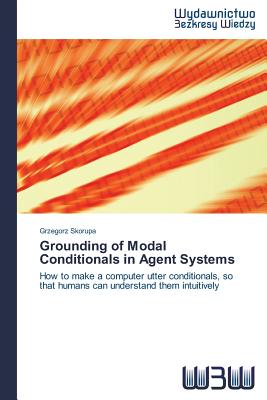
Grounding of Modal Conditionals in Agent Systems
| AUTHOR | Skorupa, Grzegorz; Skorupa Grzegorz |
| PUBLISHER | Wydawnictwo Bezkresy Wiedzy (10/24/2014) |
| PRODUCT TYPE | Paperback (Paperback) |
Description
The book considers the grounding problem for natural language sentences in form of modal conditionals. The modality is encoded in a form of the three modal operators of: possibility, belief and knowledge. It is assumed the meaning of conditionals should be anchored in the subjective and incomplete knowledge of the speaker (the cognitive agent). According to this assumption an original model realizing the grounding of conditionals is presented. Conventional semantics are defined for various formulas representing different modal conditionals are defined within the model. The semantics include subjective knowledge state of the agent, who is the message source. The semantics are defined according to an intuitive understanding of the natural language conditional sentence. A model for grounding of the conditionals is proposed. This model is later is verified against the previously outlined common-sense constraints. This allows to formulate a theory for grounding of the modal conditionals. The theory consists of a set of analytically proven theorems. Those theorems prove that it is possible to design an artificial agent that shall be able to extract consistent message sets.
Show More
Product Format
Product Details
ISBN-13:
9783639891690
ISBN-10:
3639891694
Binding:
Paperback or Softback (Trade Paperback (Us))
Content Language:
English
More Product Details
Page Count:
148
Carton Quantity:
48
Product Dimensions:
6.00 x 0.34 x 9.00 inches
Weight:
0.50 pound(s)
Country of Origin:
US
Subject Information
BISAC Categories
Computers | General
Descriptions, Reviews, Etc.
publisher marketing
The book considers the grounding problem for natural language sentences in form of modal conditionals. The modality is encoded in a form of the three modal operators of: possibility, belief and knowledge. It is assumed the meaning of conditionals should be anchored in the subjective and incomplete knowledge of the speaker (the cognitive agent). According to this assumption an original model realizing the grounding of conditionals is presented. Conventional semantics are defined for various formulas representing different modal conditionals are defined within the model. The semantics include subjective knowledge state of the agent, who is the message source. The semantics are defined according to an intuitive understanding of the natural language conditional sentence. A model for grounding of the conditionals is proposed. This model is later is verified against the previously outlined common-sense constraints. This allows to formulate a theory for grounding of the modal conditionals. The theory consists of a set of analytically proven theorems. Those theorems prove that it is possible to design an artificial agent that shall be able to extract consistent message sets.
Show More
List Price $60.37
Your Price
$59.77