
Back to Search

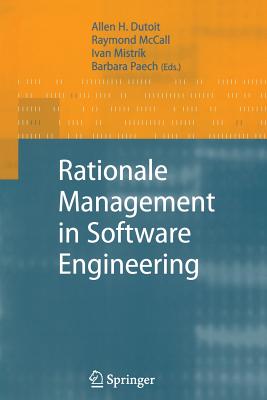
Rationale Management in Software Engineering

PUBLISHER Springer (09/21/2014)
PRODUCT TYPE Paperback (Paperback)

Description
Thirty years ago, I first entered the dark realm of software engineering, through a prior interest in documentation. In those days, documentation pretty much meant functional specifications. The idea that stakeholders in a system (its implementers, its end-users, its maintainers, and so forth) might want something other than an alphabetic list of function definitions was just taking hold. There was an exciting (to me) vision of stakeholders accessing and contributing to explanations of how and why aspects of a system work as they do, tradeoff analysis of concomitant downsides, and perhaps even accounts of why other possible approaches were not followed. There were many challenges to overcome in achieving this vision. The most formidable is the belief that people do not like to create or use do- mentation. This negative image of documentation is (unfortunately) more than just the bias of a few incorrigible system developers. It is more like a deep truth about human information behavior, about how human beings construe and act towards information. Humans are, by default, active users of information; they want to try things out, and get things done. When documentation is interposed as a prerequisite between people and a desired activity, they try to skip through it, circumvent it, or undermine it. Desi- ing information to suit the needs and interests of its users is an abiding challenge, but we have come a long way from functional specifications as the only answer.
Show More
Product Format
Product Details
ISBN-13: 9783642068164
ISBN-10: 3642068162
Binding: Paperback or Softback (Trade Paperback (Us))
Content Language: English
More Product Details
Page Count: 434
Carton Quantity: 18
Product Dimensions: 6.14 x 0.92 x 9.21 inches
Weight: 1.40 pound(s)
Feature Codes: Illustrated
Country of Origin: NL
Subject Information
BISAC Categories
Computers | Computer Science
Computers | Software Development & Engineering - General
Computers | Information Technology
Dewey Decimal: 005.12
Descriptions, Reviews, Etc.
publisher marketing
Thirty years ago, I first entered the dark realm of software engineering, through a prior interest in documentation. In those days, documentation pretty much meant functional specifications. The idea that stakeholders in a system (its implementers, its end-users, its maintainers, and so forth) might want something other than an alphabetic list of function definitions was just taking hold. There was an exciting (to me) vision of stakeholders accessing and contributing to explanations of how and why aspects of a system work as they do, tradeoff analysis of concomitant downsides, and perhaps even accounts of why other possible approaches were not followed. There were many challenges to overcome in achieving this vision. The most formidable is the belief that people do not like to create or use do- mentation. This negative image of documentation is (unfortunately) more than just the bias of a few incorrigible system developers. It is more like a deep truth about human information behavior, about how human beings construe and act towards information. Humans are, by default, active users of information; they want to try things out, and get things done. When documentation is interposed as a prerequisite between people and a desired activity, they try to skip through it, circumvent it, or undermine it. Desi- ing information to suit the needs and interests of its users is an abiding challenge, but we have come a long way from functional specifications as the only answer.
Show More

Editor: McCall, Raymond
Janet E. Burge is an Assistant Professor at Miami University Computer Science and Systems Analysis Department. Her major research interests are in Software Engineering and Artificial Intelligence. Her primary research area is in Design Rationale, with a focus on Design Rationale for Software Maintenance. She received her PhD in Computer Science from WPI in 2005, her M.S in Computer Science from WPI in 1999, and her B.S. in Computer Science from Michigan Technological University in 1984.

John M. Carroll is the Edward M. Frymoyer Chair Professor of Information Sciences and Technology at the Pennsylvania State University. His research interests include methods and theory in human-computer interaction, particularly as applied to networking tools for collaborative learning and problem solving, and the design of interactive information systems. He serves on several editorial boards for journals, handbooks, and series and is Editor-in-Chief of the ACM Transactions on Computer-Human Interactions. He received the Rigo Award and the CHI Lifetime Achievement Award from ACM, the Silver Core Award from IFIP, and the Alfred N. Goldsmith Award from IEEE. He is a fellow of the ACM, IEEE, and HFES.

Raymond McCall is an Associate Professor in the Department of Planning and Design at the University of Colorado, Denver. His major areas of research are in design rationale methods and systems. Since 1992, most of his research has concentrated on the use of rationale to support the design of artifacts for human exploration of space. For much of this time he collaborated with NASA contractors and with employees of the Johnson Space Center in Houston. He has nearly 30 years of experience indesign rationale usage in architectural design, planning, policy making and software design. He created the first hypertext systems for support of design rationale in the 1970s and 1980s and was the first to integrate support for rationale capture and delivery into 3D computer-aided design systems.

Ivan MistrA--k is an independent consultant for software-intensive systems engineering. He has 40 years experience in both software and systems engineering as an information systems developer, R&D leader, research analyst, and ICT management consultant. He is the author or co-author of more than 80 articles and papers in international journals, conferences, books and workshops and was an editor of the Special Issue on "Relating Software Requirements and Architectures" published in 2005.

Show More
List Price $109.00
Your Price  $107.91
Paperback