
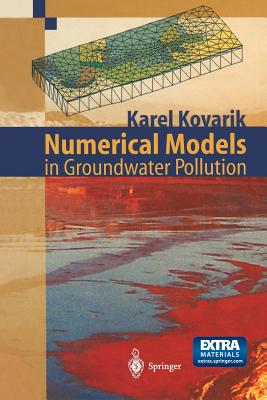
Numerical Models in Groundwater Pollution
| AUTHOR | Kovarik, Karel |
| PUBLISHER | Springer (10/03/2013) |
| PRODUCT TYPE | Paperback (Paperback) |
Description
Mathematical models are the effective tool to solve different tasks predicting pollutant movement. The finite difference method is the oldest, but still remains widely used in hydrogeological practice. However, this method is not very useful to construct the new transport models because it cannot approximate the shape of remediation elements exactly. Therefore the book is concerned with the FEM (Finite Element Method) and BEM (Boundary Element Method), and also with the comparison of advantages of these methods in groundwater hydrology. The combination of the BEM and the random-walk particle tracking method, which seems to be a very useful tool to model the spread of pollution in groundwater, are also presented. The computer programmes have been developed on the basis of the theoretical backgrounds of these methods. They use the Visual C++ programming language for Windows 95/NT platform and will be included in the book.
Show More
Product Format
Product Details
ISBN-13:
9783642630989
ISBN-10:
3642630987
Binding:
Paperback or Softback (Trade Paperback (Us))
Content Language:
English
More Product Details
Page Count:
224
Carton Quantity:
32
Product Dimensions:
6.14 x 0.51 x 9.21 inches
Weight:
0.76 pound(s)
Country of Origin:
NL
Subject Information
BISAC Categories
Science | Earth Sciences - Hydrology
Science | Environmental - Pollution Control
Science | Earth Sciences - Meteorology & Climatology
Dewey Decimal:
363.739
Descriptions, Reviews, Etc.
publisher marketing
Mathematical models are the effective tool to solve different tasks predicting pollutant movement. The finite difference method is the oldest, but still remains widely used in hydrogeological practice. However, this method is not very useful to construct the new transport models because it cannot approximate the shape of remediation elements exactly. Therefore the book is concerned with the FEM (Finite Element Method) and BEM (Boundary Element Method), and also with the comparison of advantages of these methods in groundwater hydrology. The combination of the BEM and the random-walk particle tracking method, which seems to be a very useful tool to model the spread of pollution in groundwater, are also presented. The computer programmes have been developed on the basis of the theoretical backgrounds of these methods. They use the Visual C++ programming language for Windows 95/NT platform and will be included in the book.
Show More
List Price $109.99
Your Price
$108.89