
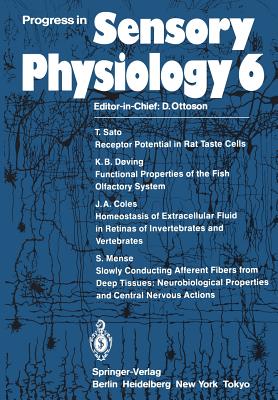
Progress in Sensory Physiology
| PUBLISHER | Springer (12/06/2011) |
| PRODUCT TYPE | Paperback (Paperback) |
Description
1. Themeanrestingmembranepotentialofrattaste cells is - 36 mVunderadap- tation of the tongue to 41.4 mMNaCI and - 50mV under water adaptation. 2. The shapes ofreceptor potentials ofrattastecells inresponsetothe four basic tastestimuli(0.5MNaCI, 0.02 M Q-HCI, 0.01 MHCl, and0.5 M sucrose)are classified into three types, namely (1) a depolarization alone, (2) a depolariza- tion preceded by a transient hyperpolarization, and (3) a hyperpolarization alone. No regenerative spike potentials are evoked in rat taste cells by chemical stimuli. The amplitude of rat taste cell responses increases with increasing concentrationofthe taste stimulus. Mostofthe rat taste cells show a multiple sensitivity in that single cells respond to various combinations of the four basic taste stimuli with depolarizations or hyperpolarizations. 3. The rise and fall times of depolarizing responses to 0.5 M NaCI are much shorter than those of depolarizing responses to the other three stimuli. The fall time of depolarization evoked by 0.01 M HCI is the longest. The rise and fall times of all hyperpolarizing responses are shorter than those of all de- polarizing responses.
Show More
Product Format
Product Details
ISBN-13:
9783642704130
ISBN-10:
3642704131
Binding:
Paperback or Softback (Trade Paperback (Us))
Content Language:
English
More Product Details
Page Count:
228
Carton Quantity:
18
Product Dimensions:
6.69 x 0.50 x 9.61 inches
Weight:
0.84 pound(s)
Country of Origin:
NL
Subject Information
BISAC Categories
Medical | Neuroscience
Medical | Physiology
Medical | Life Sciences - Human Anatomy & Physiology
Dewey Decimal:
612
Descriptions, Reviews, Etc.
publisher marketing
1. Themeanrestingmembranepotentialofrattaste cells is - 36 mVunderadap- tation of the tongue to 41.4 mMNaCI and - 50mV under water adaptation. 2. The shapes ofreceptor potentials ofrattastecells inresponsetothe four basic tastestimuli(0.5MNaCI, 0.02 M Q-HCI, 0.01 MHCl, and0.5 M sucrose)are classified into three types, namely (1) a depolarization alone, (2) a depolariza- tion preceded by a transient hyperpolarization, and (3) a hyperpolarization alone. No regenerative spike potentials are evoked in rat taste cells by chemical stimuli. The amplitude of rat taste cell responses increases with increasing concentrationofthe taste stimulus. Mostofthe rat taste cells show a multiple sensitivity in that single cells respond to various combinations of the four basic taste stimuli with depolarizations or hyperpolarizations. 3. The rise and fall times of depolarizing responses to 0.5 M NaCI are much shorter than those of depolarizing responses to the other three stimuli. The fall time of depolarization evoked by 0.01 M HCI is the longest. The rise and fall times of all hyperpolarizing responses are shorter than those of all de- polarizing responses.
Show More
List Price $109.99
Your Price
$108.89