
Back to Search

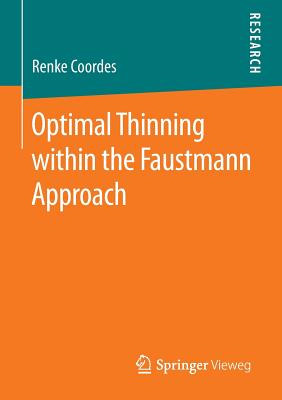
Optimal Thinning Within the Faustmann Approach

AUTHOR Coordes, Renke
PUBLISHER Springer Vieweg (08/25/2014)
PRODUCT TYPE Paperback (Paperback)

Description
Forest stands are thinned all over the world. Yet, there was hitherto no consistent theory which allowed deriving unambiguous conditions for thinnings as the harvest of trees prior to the rotation age. Renke Coordes closes this gap by proposing a new, more general view on the Faustmann model as the basic investment model in forest resource economics. With the introduction of mutual interdependencies between the trees growing in a stand and the opportunity to harvest trees prior to the rotation age, optimal thinning regimes can be derived and analyzed. The implications of the proposed model are thoroughly discussed against the background of practical forest management decisions. The author closes with adaptations to the problems of the management of mixed, multiple-use and uneven-aged stands and entire forests. In this way, a unified perspective on the management of forests as natural resources is offered.
Show More
Product Format
Product Details
ISBN-13: 9783658069582
ISBN-10: 3658069589
Binding: Paperback or Softback (Trade Paperback (Us))
Content Language: English
More Product Details
Page Count: 246
Carton Quantity: 28
Product Dimensions: 5.83 x 0.60 x 8.27 inches
Weight: 0.77 pound(s)
Feature Codes: Illustrated
Country of Origin: NL
Subject Information
BISAC Categories
Technology & Engineering | Agriculture - Forestry
Technology & Engineering | Environmental - General
Technology & Engineering | Natural Resources
Dewey Decimal: 333.7
Descriptions, Reviews, Etc.
jacket back

Forest stands are thinned all over the world. Yet, there was hitherto no consistent theory which allowed deriving unambiguous conditions for thinnings as the harvest of trees prior to the rotation age. Renke Coordes closes this gap by proposing a new, more general view on the Faustmann model as the basic investment model in forest resource economics. With the introduction of mutual interdependencies between the trees growing in a stand and the opportunity to harvest trees prior to the rotation age, optimal thinning regimes can be derived and analyzed. The implications of the proposed model are thoroughly discussed against the background of practical forest management decisions. The author closes with adaptations to the problems of the management of mixed, multiple-use and uneven-aged stands and entire forests. In this way, a unified perspective on the management of forests as natural resources is offered.

Contents

  • Impact of thinnings on the timber growth in forest stands
  • Investment models for thinning decisions in forest stands
  • Analysis of the optimality and relevance of thinning regimes in forest stands
  • Conclusions on the management of mixed and uneven-aged stands and forests

Target Groups

  • Researchers and students in the fields of forest science and resource economics
  • Practitioners in the fields of forest management and resource management

About the Author

Renke Coordes is Research Assistant and Lecturer at the Institute of Forest Economics and Forest Management Planning of the university Technische Universitt Dresden.

Show More
publisher marketing
Forest stands are thinned all over the world. Yet, there was hitherto no consistent theory which allowed deriving unambiguous conditions for thinnings as the harvest of trees prior to the rotation age. Renke Coordes closes this gap by proposing a new, more general view on the Faustmann model as the basic investment model in forest resource economics. With the introduction of mutual interdependencies between the trees growing in a stand and the opportunity to harvest trees prior to the rotation age, optimal thinning regimes can be derived and analyzed. The implications of the proposed model are thoroughly discussed against the background of practical forest management decisions. The author closes with adaptations to the problems of the management of mixed, multiple-use and uneven-aged stands and entire forests. In this way, a unified perspective on the management of forests as natural resources is offered.
Show More
List Price $54.99
Your Price  $54.44
Paperback