
Back to Search

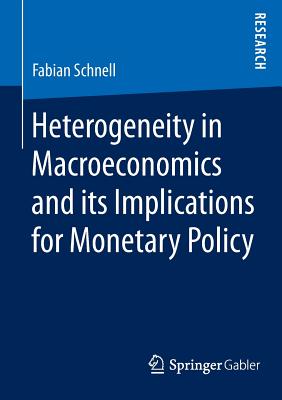
Heterogeneity in Macroeconomics and Its Implications for Monetary Policy

AUTHOR Schnell, Fabian
PUBLISHER Springer Gabler (05/07/2015)
PRODUCT TYPE Paperback (Paperback)

Description
Fabian Schnell develops a model indicating that by keeping real interest rates too low, monetary policy can distort the allocation of resources across firms and potentially delay economic recovery after a recession. This is a new channel of monetary policy that is especially relevant in view of "Quantitative Easing" programs. A second model focuses on the short-term implications of heterogeneously productive firms, showing an acceleration effect of technology shocks. Finally, an empirical investigation of firms' price-setting behaviors shows that time-dependent factors, relative to state-dependent ones, play a small role with respect to the probability and the size of a price change. All results provide new insights for monetary policy.
Show More
Product Format
Product Details
ISBN-13: 9783658097301
ISBN-10: 3658097302
Binding: Paperback or Softback (Trade Paperback (Us))
Content Language: English
More Product Details
Page Count: 166
Carton Quantity: 38
Product Dimensions: 5.83 x 0.43 x 8.27 inches
Weight: 0.55 pound(s)
Feature Codes: Illustrated
Country of Origin: NL
Subject Information
BISAC Categories
Business & Economics | Economics - General
Dewey Decimal: 330
Descriptions, Reviews, Etc.
jacket back

Fabian Schnell develops a model indicating that by keeping real interest rates too low, monetary policy can distort the allocation of resources across firms and potentially delay economic recovery after a recession. This is a new channel of monetary policy that is especially relevant in view of "Quantitative Easing" programs. A second model focuses on the short-term implications of heterogeneously productive firms, showing an acceleration effect of technology shocks. Finally, an empirical investigation of firms' price-setting behaviors shows that time-dependent factors, relative to state-dependent ones, play a small role with respect to the probability and the size of a price change. All results provide new insights for monetary policy.

Contents

  • Introduction: Heterogeneity and Macroeconomics
  • Can Monetary Policy Delay the Reallocation of Capital?
  • Business Cycles and Monetary Policy with Productivity Heterogeneity
  • What Determines Price Changes and the Distribution of Prices? Evidence from the Swiss CPI

    Target Groups

  • Researchers and students in macroeconomics
  • Governmental institutions and central banks
  • Managers of commercial banks, nongovernmental organizations, think tanks

The Author

Fabian Schnell, Ph.D., works as a research associate at theUniversity of St. Gallen and as a project leader for economic policy at economiesuisse, the Swiss Business Federation.

Show More
publisher marketing
Fabian Schnell develops a model indicating that by keeping real interest rates too low, monetary policy can distort the allocation of resources across firms and potentially delay economic recovery after a recession. This is a new channel of monetary policy that is especially relevant in view of "Quantitative Easing" programs. A second model focuses on the short-term implications of heterogeneously productive firms, showing an acceleration effect of technology shocks. Finally, an empirical investigation of firms' price-setting behaviors shows that time-dependent factors, relative to state-dependent ones, play a small role with respect to the probability and the size of a price change. All results provide new insights for monetary policy.
Show More
List Price $54.99
Your Price  $54.44
Paperback