
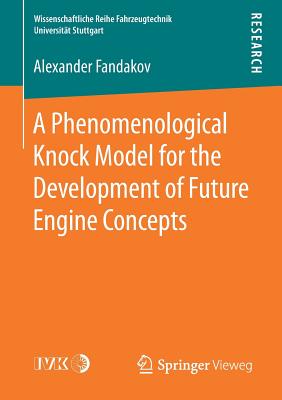
A Phenomenological Knock Model for the Development of Future Engine Concepts
| AUTHOR | Fandakov, Alexander |
| PUBLISHER | Springer Vieweg (01/08/2019) |
| PRODUCT TYPE | Paperback (Paperback) |
The majority of 0D/1D knock models available today are known for their poor accuracy and the great effort needed for their calibration. Alexander Fandakov presents a novel, extensively validated phenomenological knock model for the development of future engine concepts within a 0D/1D simulation environment that has one engine-specific calibration parameter. Benchmarks against the models commonly used in the automotive industry reveal the huge gain in knock boundary prediction accuracy achieved with the approach proposed in this work. Thus, the new knock model contributes substantially to the efficient design of spark ignition engines employing technologies such as full-load exhaust gas recirculation, water injection, variable compression ratio or lean combustion.
About the Author
Alexander Fandakov holds a PhD in automotive powertrain engineering from the Institute of Internal Combustion Engines and Automotive Engineering (IVK) at the University of Stuttgart, Germany. Currently, he is working as an advanced powertrain development engineer in the automotive industry.
Contents
- Experimental Investigations and Thermodynamic Analysis
- Unburnt Mixture Auto-Ignition Prediction
- Knock Occurrence Criterion
- Knock Model Validation
- Researchers and students in the field of automotive engineering, especially internal combustion engine simulation and modeling
- Automotive powertrain developers and automotive engineers in general
The majority of 0D/1D knock models available today are known for their poor accuracy and the great effort needed for their calibration. Alexander Fandakov presents a novel, extensively validated phenomenological knock model for the development of future engine concepts within a 0D/1D simulation environment that has one engine-specific calibration parameter. Benchmarks against the models commonly used in the automotive industry reveal the huge gain in knock boundary prediction accuracy achieved with the approach proposed in this work. Thus, the new knock model contributes substantially to the efficient design of spark ignition engines employing technologies such as full-load exhaust gas recirculation, water injection, variable compression ratio or lean combustion.
About the Author
Alexander Fandakov holds a PhD in automotive powertrain engineering from the Institute of Internal Combustion Engines and Automotive Engineering (IVK) at the University of Stuttgart, Germany. Currently, he is working as an advanced powertrain development engineer in the automotive industry.