
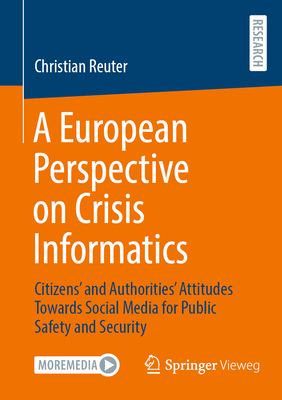
A European Perspective on Crisis Informatics: Citizens' and Authorities' Attitudes Towards Social Media for Public Safety and Security
| AUTHOR | Reuter, Christian |
| PUBLISHER | Springer Vieweg (11/13/2022) |
| PRODUCT TYPE | Paperback (Paperback) |
Description
Mobilising helpers in the event of a flood or letting friends know that you are okay in the event of a terrorist attack - more and more people are using social media in emergency, crisis or disaster situations. Storms, floods, attacks or pandemics (esp. COVID-19) show that citizens use social media to inform themselves or to coordinate. This book presents qualitative and quantitative studies on the attitudes of emergency services and citizens in Europe towards social media in emergencies. Across the individual sub-studies, almost 10,000 people are surveyed including representative studies in the Netherlands, Germany, the UK and Italy. The work empirically shows that social media is increasingly important for emergency services, both for prevention and during crises; that private use of social media is a driving force in shaping opinions for organisational use; and that citizens have high expectations towards authorities, especially monitoring social media is expected, and sometimes responses within one hour. Depending on the risk culture, the data show further differences, e.g. whether the state (Germany) or the individual (Netherlands) is seen as primarily responsible for coping with the situation.
Show More
Product Format
Product Details
ISBN-13:
9783658397197
ISBN-10:
3658397195
Binding:
Paperback or Softback (Trade Paperback (Us))
Content Language:
English
More Product Details
Page Count:
281
Carton Quantity:
24
Product Dimensions:
5.83 x 0.68 x 8.27 inches
Weight:
0.88 pound(s)
Feature Codes:
Illustrated
Country of Origin:
NL
Subject Information
BISAC Categories
Computers | Security - General
Computers | Media Studies
Descriptions, Reviews, Etc.
jacket back
Mobilising helpers in the event of a flood or letting friends know that you are okay in the event of a terrorist attack - more and more people are using social media in emergency, crisis or disaster situations. Storms, floods, attacks or pandemics (esp. COVID-19) show that citizens use social media to inform themselves or to coordinate. This book presents qualitative and quantitative studies on the attitudes of emergency services and citizens in Europe towards social media in emergencies. Across the individual sub-studies, almost 10,000 people are surveyed including representative studies in the Netherlands, Germany, the UK and Italy. The work empirically shows that social media is increasingly important for emergency services, both for prevention and during crises; that private use of social media is a driving force in shaping opinions for organisational use; and that citizens have high expectations towards authorities, especially monitoring social media is expected, and sometimes responses within one hour. Depending on the risk culture, the data show further differences, e.g. whether the state (Germany) or the individual (Netherlands) is seen as primarily responsible for coping with the situation.
About the authorChristian Reuter holds a Ph.D. in Information Systems (University of Siegen) and another Ph.D. in the Politics of Safety and Security (Radboud University Nijmegen) and works as a Professor for Science and Technology for Peace and Security (PEASEC) at Technical University of Darmstadt.
About the authorChristian Reuter holds a Ph.D. in Information Systems (University of Siegen) and another Ph.D. in the Politics of Safety and Security (Radboud University Nijmegen) and works as a Professor for Science and Technology for Peace and Security (PEASEC) at Technical University of Darmstadt.
Show More
publisher marketing
Mobilising helpers in the event of a flood or letting friends know that you are okay in the event of a terrorist attack - more and more people are using social media in emergency, crisis or disaster situations. Storms, floods, attacks or pandemics (esp. COVID-19) show that citizens use social media to inform themselves or to coordinate. This book presents qualitative and quantitative studies on the attitudes of emergency services and citizens in Europe towards social media in emergencies. Across the individual sub-studies, almost 10,000 people are surveyed including representative studies in the Netherlands, Germany, the UK and Italy. The work empirically shows that social media is increasingly important for emergency services, both for prevention and during crises; that private use of social media is a driving force in shaping opinions for organisational use; and that citizens have high expectations towards authorities, especially monitoring social media is expected, and sometimes responses within one hour. Depending on the risk culture, the data show further differences, e.g. whether the state (Germany) or the individual (Netherlands) is seen as primarily responsible for coping with the situation.
Show More
List Price $99.99
Your Price
$98.99