
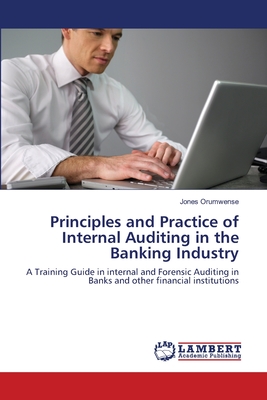
Principles and Practice of Internal Auditing in the Banking Industry
| AUTHOR | Orumwense Jones; Orumwense, Jones |
| PUBLISHER | LAP Lambert Academic Publishing (02/26/2013) |
| PRODUCT TYPE | Paperback (Paperback) |
Description
Internal Audit is a department, independent of line Management, whose prime responsibility is to review the quality and effectiveness of the controls within the Banks and mitigate risk and protect the assets of the Bank. In performing this work, internal audit provides recommendations and advice to management on matters requiring attention. Internal audit will normally produce an annual plan of work to be performed, concentrating on areas of higher risk. Structured timetables and work programs(e.g.audit programs)will be designed for each assignment. At the end review, an audit report will normally be prepared for senior management attention and action. ad-hoc assignments may also be performed at the request of senior management where problems or irregularities require further investigation. further, there are real advantages in ongoing internal audit involvement in major projects, including systems developments. In this way audit concern can be addressed up-front and action taken before the problem becomes too entrenched.
Show More
Product Format
Product Details
ISBN-13:
9783659356261
ISBN-10:
3659356263
Binding:
Paperback or Softback (Trade Paperback (Us))
Content Language:
English
More Product Details
Page Count:
240
Carton Quantity:
34
Product Dimensions:
6.00 x 0.55 x 9.00 inches
Weight:
0.79 pound(s)
Country of Origin:
US
Subject Information
BISAC Categories
Business & Economics | Banks & Banking
Descriptions, Reviews, Etc.
publisher marketing
Internal Audit is a department, independent of line Management, whose prime responsibility is to review the quality and effectiveness of the controls within the Banks and mitigate risk and protect the assets of the Bank. In performing this work, internal audit provides recommendations and advice to management on matters requiring attention. Internal audit will normally produce an annual plan of work to be performed, concentrating on areas of higher risk. Structured timetables and work programs(e.g.audit programs)will be designed for each assignment. At the end review, an audit report will normally be prepared for senior management attention and action. ad-hoc assignments may also be performed at the request of senior management where problems or irregularities require further investigation. further, there are real advantages in ongoing internal audit involvement in major projects, including systems developments. In this way audit concern can be addressed up-front and action taken before the problem becomes too entrenched.
Show More
Your Price
$101.32