
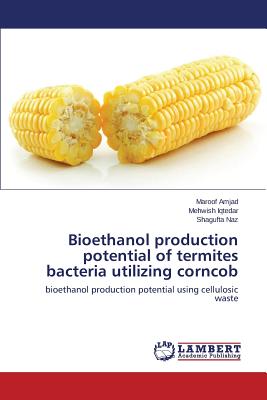
Bioethanol production potential of termites bacteria utilizing corncob
| AUTHOR | Amjad Maroof; Iqtedar Mehwish; Naz Shagufta |
| PUBLISHER | LAP Lambert Academic Publishing (10/21/2014) |
| PRODUCT TYPE | Paperback (Paperback) |
Description
The current study aimed at the lab scale production of bioethanol from corncob employing cellulolytic bacteria isolated from termite gut. Cellulolytic bacteria were isolated from two local termite species including Coptotermes heimi and Microtermes mycophagous. Corn cob was de-lignified. Two fold decrease in lignin and 20% increase in cellulose was obtained after pretreatment. Among six bacterial isolated CH-1 and MYC-1 were selected for their potential cellulolytic action through halo zone formation in primary screening and substrate hydrolysis during secondary screening. Temperature, pH, substrate concentration, inoculum size, surfactants, metal ions, PEG concentration, CMCase and FPase activity were optimized for CH-1 and MYC-1. Optimal bioethanol yield was 5.45 mg/ml and 5.79 mg/ml from CH-1 and MYC-1 respectively by simultaneous saccharification and fermentation. 16S rDNA sequence analysis has shown homology with Bacillus cereus (CH-1) and Providencia vermicola. (MYC-1). Therefore it can be concluded that both isolates had shown potential bioconversion of agro-waste into fermentable sugars that later could be fermented to bioethanol.
Show More
Product Format
Product Details
ISBN-13:
9783659621673
ISBN-10:
3659621676
Binding:
Paperback or Softback (Trade Paperback (Us))
Content Language:
English
More Product Details
Page Count:
160
Carton Quantity:
44
Product Dimensions:
6.00 x 0.37 x 9.00 inches
Weight:
0.54 pound(s)
Country of Origin:
US
Subject Information
BISAC Categories
Science | Life Sciences - Microbiology
Descriptions, Reviews, Etc.
publisher marketing
The current study aimed at the lab scale production of bioethanol from corncob employing cellulolytic bacteria isolated from termite gut. Cellulolytic bacteria were isolated from two local termite species including Coptotermes heimi and Microtermes mycophagous. Corn cob was de-lignified. Two fold decrease in lignin and 20% increase in cellulose was obtained after pretreatment. Among six bacterial isolated CH-1 and MYC-1 were selected for their potential cellulolytic action through halo zone formation in primary screening and substrate hydrolysis during secondary screening. Temperature, pH, substrate concentration, inoculum size, surfactants, metal ions, PEG concentration, CMCase and FPase activity were optimized for CH-1 and MYC-1. Optimal bioethanol yield was 5.45 mg/ml and 5.79 mg/ml from CH-1 and MYC-1 respectively by simultaneous saccharification and fermentation. 16S rDNA sequence analysis has shown homology with Bacillus cereus (CH-1) and Providencia vermicola. (MYC-1). Therefore it can be concluded that both isolates had shown potential bioconversion of agro-waste into fermentable sugars that later could be fermented to bioethanol.
Show More
Your Price
$92.21