
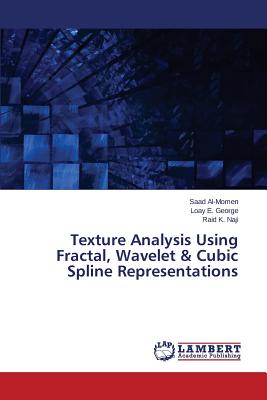
Texture Analysis Using Fractal, Wavelet & Cubic Spline Representations
| AUTHOR | Al-Momen Saad; Naji Raid K.; George Loay E. |
| PUBLISHER | LAP Lambert Academic Publishing (06/26/2015) |
| PRODUCT TYPE | Paperback (Paperback) |
Description
Texture classification is the process to classify different textures from the given images. It is implemented in a large variety of real world problems involving specific textures of different objects. Some of the real world applications that involve textured objects of surfaces include rock classification, wood species recognition, face detection, fabric classification, geographical landscape segmentation, etc. All these applications allowed the target subjects to be viewed as a specific type of texture and hence, they can be solved using texture classification techniques. Due to this variety of applications, there is a variety in the texture types and every type has to be treated carefully according to its significant properties. Feature extraction is an important process for texture classification. This work introduces several sets of feature according to the type of texture. Three types of textures (datasets) were studied; dataset#1 consists of gray texture with directional properties where the woven fabric texture is taken as an example, dataset#2 consists of gray texture have no dominant directional properties, while dataset#3 consists of color texture taken from skin tissues
Show More
Product Format
Product Details
ISBN-13:
9783659748974
ISBN-10:
3659748978
Binding:
Paperback or Softback (Trade Paperback (Us))
Content Language:
English
More Product Details
Page Count:
92
Carton Quantity:
76
Product Dimensions:
6.00 x 0.22 x 9.00 inches
Weight:
0.32 pound(s)
Country of Origin:
US
Subject Information
BISAC Categories
Mathematics | General
Descriptions, Reviews, Etc.
publisher marketing
Texture classification is the process to classify different textures from the given images. It is implemented in a large variety of real world problems involving specific textures of different objects. Some of the real world applications that involve textured objects of surfaces include rock classification, wood species recognition, face detection, fabric classification, geographical landscape segmentation, etc. All these applications allowed the target subjects to be viewed as a specific type of texture and hence, they can be solved using texture classification techniques. Due to this variety of applications, there is a variety in the texture types and every type has to be treated carefully according to its significant properties. Feature extraction is an important process for texture classification. This work introduces several sets of feature according to the type of texture. Three types of textures (datasets) were studied; dataset#1 consists of gray texture with directional properties where the woven fabric texture is taken as an example, dataset#2 consists of gray texture have no dominant directional properties, while dataset#3 consists of color texture taken from skin tissues
Show More
Your Price
$70.41