
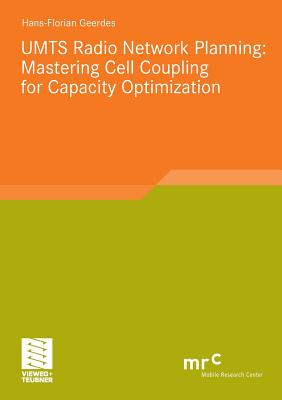
Umts Radio Network Planning: Mastering Cell Coupling for Capacity Optimization
| AUTHOR | Geerdes, Hans-Florian |
| PUBLISHER | Vieweg+teubner Verlag (09/29/2008) |
| PRODUCT TYPE | Paperback (Paperback) |
Description
The universalmobiletelecommunications system (UMTS) is a technical standard for a third generation (3G) telecommunication system. UMTS provides data rates more than three 1 times higher than its second generation (2G) predecessors. The increased speed en- ables, for example, video calls, music downloads, or fast web surfing. The technology is already widely available. In 2007, a total of 166 commercial UMTS radio networks are operational in 66 countries covering all continents (UMTS Forum, 20 7), and there are already more than 100 million UMTS subscribers (3GToday. com, 2007; UMTS Forum, 2006). The market for mobile telecommunication is, however, increasingly competi- tive, therefore operators need to invest effectively. In Western Europe, mobile phone penetration has reached 100 % in 2006 and the average revenue per customer is de- clining (3G. co. uk, 2007). Besides spectrum license fees, the main cost driver is network infrastructure (Ellingeret al., 2002). Radio network planning can cut operational and capital expenditure by up to 30 % (Dehghan, 2005). Good radio network planning is difficult for UMTS, because its radio interface is more complex than anything used at mass-market level before (Dehghan, 2005). Con- nections are separated via codes; they share the same frequency band and are thus subject to interference. On each link, the system constantly regulates the amount of generated interference to a minimum via a power-control feedback loop.
Show More
Product Format
Product Details
ISBN-13:
9783834806970
ISBN-10:
3834806978
Binding:
Paperback or Softback (Trade Paperback (Us))
Content Language:
English
More Product Details
Page Count:
186
Carton Quantity:
40
Product Dimensions:
5.83 x 0.42 x 8.27 inches
Weight:
0.54 pound(s)
Country of Origin:
US
Subject Information
BISAC Categories
Computers | Computer Science
Computers | Telecommunications
Computers | Networking - Hardware
Dewey Decimal:
004
Descriptions, Reviews, Etc.
jacket back
Interference determines the performance of UMTS radio networks. In order to provide good coverage and high capacity, network operators need to control the effects and dynamics of interference coupling among users and cells. This is a major challenge in planning and optimizing UMTS radio networks. Hans-Florian Geerdes establishes a concise system model, which describes interference coupling and its impact on the network. The system model enables an efficient analysis of radio network performance. It is also the basis for new automatic planning algorithms. Extensive computational experiments on realistic data demonstrate that the presented evaluation and optimization methods are well-suited tools for use in practice.
Show More
publisher marketing
The universalmobiletelecommunications system (UMTS) is a technical standard for a third generation (3G) telecommunication system. UMTS provides data rates more than three 1 times higher than its second generation (2G) predecessors. The increased speed en- ables, for example, video calls, music downloads, or fast web surfing. The technology is already widely available. In 2007, a total of 166 commercial UMTS radio networks are operational in 66 countries covering all continents (UMTS Forum, 20 7), and there are already more than 100 million UMTS subscribers (3GToday. com, 2007; UMTS Forum, 2006). The market for mobile telecommunication is, however, increasingly competi- tive, therefore operators need to invest effectively. In Western Europe, mobile phone penetration has reached 100 % in 2006 and the average revenue per customer is de- clining (3G. co. uk, 2007). Besides spectrum license fees, the main cost driver is network infrastructure (Ellingeret al., 2002). Radio network planning can cut operational and capital expenditure by up to 30 % (Dehghan, 2005). Good radio network planning is difficult for UMTS, because its radio interface is more complex than anything used at mass-market level before (Dehghan, 2005). Con- nections are separated via codes; they share the same frequency band and are thus subject to interference. On each link, the system constantly regulates the amount of generated interference to a minimum via a power-control feedback loop.
Show More
List Price $109.99
Your Price
$108.89