
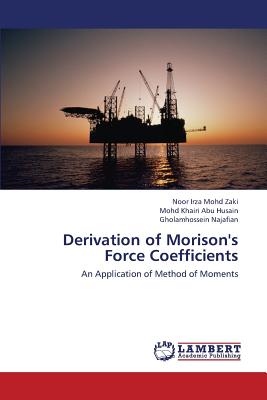
Derivation of Morison's Force Coefficients
| AUTHOR | Najafian Gholamhossein; Mohd Zaki Noor Irza; Abu Husain Mohd Khairi |
| PUBLISHER | LAP Lambert Academic Publishing (07/12/2013) |
| PRODUCT TYPE | Paperback (Paperback) |
Description
Morison's equation uses two empirical constant coefficients for drag and inertial forces calculation. The values of these empirical coefficients must be determined from laboratory and field experiments. In a typical wave load investigation, the wave force together with corresponding water particle velocity and acceleration are measured. The measured data is then analysed to calculate constant values for Morison's coefficients. One of the methods used in the derivation of Morison's coefficients is the conventional method of moments. However, the coefficients obtained from this method show considerable scatter. The purpose of this investigation is to explain the cause of the scatter and to introduce a more efficient form of the method of moments. Morison's coefficients derived from the conventional method of moments will be compared with corresponding values from the new method of moments to determine the impact of the new method in reducing the observed scatter in Morison's coefficients.
Show More
Product Format
Product Details
ISBN-13:
9783843376204
ISBN-10:
3843376204
Binding:
Paperback or Softback (Trade Paperback (Us))
Content Language:
English
More Product Details
Page Count:
60
Carton Quantity:
118
Product Dimensions:
6.00 x 0.14 x 9.00 inches
Weight:
0.22 pound(s)
Feature Codes:
Illustrated
Country of Origin:
US
Subject Information
BISAC Categories
Technology & Engineering | General
Descriptions, Reviews, Etc.
publisher marketing
Morison's equation uses two empirical constant coefficients for drag and inertial forces calculation. The values of these empirical coefficients must be determined from laboratory and field experiments. In a typical wave load investigation, the wave force together with corresponding water particle velocity and acceleration are measured. The measured data is then analysed to calculate constant values for Morison's coefficients. One of the methods used in the derivation of Morison's coefficients is the conventional method of moments. However, the coefficients obtained from this method show considerable scatter. The purpose of this investigation is to explain the cause of the scatter and to introduce a more efficient form of the method of moments. Morison's coefficients derived from the conventional method of moments will be compared with corresponding values from the new method of moments to determine the impact of the new method in reducing the observed scatter in Morison's coefficients.
Show More
Your Price
$37.06