
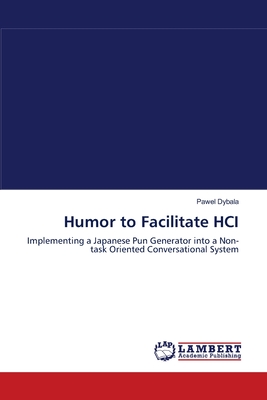
Humor to Facilitate HCI
| AUTHOR | Dybala, Pawel |
| PUBLISHER | LAP Lambert Academic Publishing (07/18/2011) |
| PRODUCT TYPE | Paperback (Paperback) |
Description
This book addresses the topic of enhancing Human-Computer Interactions with humorous contents, with particular focus laid on implementing a Japanese pun generator into a non-task oriented conversational system. The author introduces innovative research aimed at constructing humor-equipped conversational systems for Japanese. Its main focus is on placing humor generation in a daily, non-constrained dialogue between systems and humans. The author describes two such systems, each of which interacts with human users and attempts to improve the interactions with humor. Evaluation experiments showed that most users found interactions with humor-equipped systems much more interesting, pleasant, and generally better than with similar, non-humorous systems. This work is also innovative in describing the first conversational system in which the issues of humor and emotions are combined. The latest version of the system employs sophisticated affect analysis to detect users' emotions from speech, and on this basis decides if humor should be used to make the user feel better. All of these things yielded a successful system for eliciting positive emotional responses to computer-generated humor.
Show More
Product Format
Product Details
ISBN-13:
9783844326352
ISBN-10:
3844326359
Binding:
Paperback or Softback (Trade Paperback (Us))
Content Language:
English
More Product Details
Page Count:
176
Carton Quantity:
46
Product Dimensions:
6.00 x 0.41 x 9.00 inches
Weight:
0.59 pound(s)
Country of Origin:
US
Subject Information
BISAC Categories
Computers | General
Descriptions, Reviews, Etc.
publisher marketing
This book addresses the topic of enhancing Human-Computer Interactions with humorous contents, with particular focus laid on implementing a Japanese pun generator into a non-task oriented conversational system. The author introduces innovative research aimed at constructing humor-equipped conversational systems for Japanese. Its main focus is on placing humor generation in a daily, non-constrained dialogue between systems and humans. The author describes two such systems, each of which interacts with human users and attempts to improve the interactions with humor. Evaluation experiments showed that most users found interactions with humor-equipped systems much more interesting, pleasant, and generally better than with similar, non-humorous systems. This work is also innovative in describing the first conversational system in which the issues of humor and emotions are combined. The latest version of the system employs sophisticated affect analysis to detect users' emotions from speech, and on this basis decides if humor should be used to make the user feel better. All of these things yielded a successful system for eliciting positive emotional responses to computer-generated humor.
Show More
Your Price
$87.21