
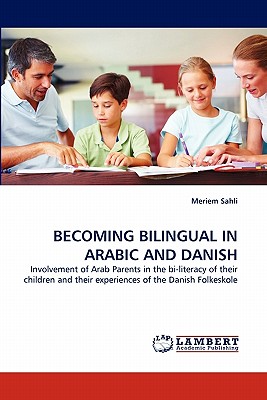
Becoming Bilingual in Arabic and Danish
| AUTHOR | Sahli, Meriem |
| PUBLISHER | LAP Lambert Academic Publishing (04/27/2011) |
| PRODUCT TYPE | Paperback (Paperback) |
Description
This study investigated the involvement of Arab parents in the schooling of their children. Data were collected by interviewing parents whose children attended schools in inner Copenhagen. The study focused on how Arab parents provided opportunities and resources to support their children with their school work and at the same time teach them their language. In the second part of this study I drew on parents' experiences in the folkeskole and their views of the educational system. The results of the study can be summarized in the following: All parents were actively involved in the learning of their children. Families who could not write and read Arabic and Danish relied on other social networks such as neighbours and bilingual staff for help. Parents gave more time helping their children with Arabic as their literacy was barely acknowledged in school. But the fact that they wanted their children to compete with Danish students on equal terms, they had chosen the folkeskole instead of Arabic private schools. Parents believed that the school system was too flexible and confusing.
Show More
Product Format
Product Details
ISBN-13:
9783844333404
ISBN-10:
3844333401
Binding:
Paperback or Softback (Trade Paperback (Us))
Content Language:
English
More Product Details
Page Count:
72
Carton Quantity:
110
Product Dimensions:
6.00 x 0.17 x 9.00 inches
Weight:
0.26 pound(s)
Country of Origin:
US
Subject Information
BISAC Categories
Education | Schools - Levels - Secondary
Descriptions, Reviews, Etc.
publisher marketing
This study investigated the involvement of Arab parents in the schooling of their children. Data were collected by interviewing parents whose children attended schools in inner Copenhagen. The study focused on how Arab parents provided opportunities and resources to support their children with their school work and at the same time teach them their language. In the second part of this study I drew on parents' experiences in the folkeskole and their views of the educational system. The results of the study can be summarized in the following: All parents were actively involved in the learning of their children. Families who could not write and read Arabic and Danish relied on other social networks such as neighbours and bilingual staff for help. Parents gave more time helping their children with Arabic as their literacy was barely acknowledged in school. But the fact that they wanted their children to compete with Danish students on equal terms, they had chosen the folkeskole instead of Arabic private schools. Parents believed that the school system was too flexible and confusing.
Show More
Your Price
$62.84